Wednesday, June 14, 2006


CHAPTER XXVI:

'LITTLE FLOWERS' CONTINUED . . .


HOW ST FRANCIS CONVERTED CERTAIN ROBBERS AND ASSASSINS, WHO BECAME FRIARS; AND OF A WONDERFUL VISION WHICH APPEARED TO ONE OF THEM WHO WAS A MOST HOLY BROTHER


As St Francis went one day through the desert of Borgo di San Sepolcro, and was passing by a castle called Monte Casale, he saw a young man of noble mien, and elegant in appearance, coming towards him, who thus addressed him: “Father, I would willingly be one of thy monks.” St Francis answered: “My son, thou art young, noble, and delicate; perhaps thou wouldst not be able to endure poverty and hardships.” The young man said again: “Father, are you not men, like me? If you, then, can support these things, through the grace of God I shall be able to do so likewise.” This answer greatly pleased St Francis, and giving the young man his blessing, he received him immediately into the Order, and gave him the name of Brother Angelo. And this young man was so remarkable and so distinguished, that shortly after he was named Guardian of the Convent of Monte Casale. At that time there were three famous robbers in that part of the country, who did much evil in all the neighbourhood. Coming one day to the said convent, they asked Brother Angelo, the guardian, to give them something to eat. The guardian, reproving them harshly, answered thus: “Cruel robbers and murderers, you are not ashamed to deprive others of the fruits of their labours, and you have the audacity to come here and devour that which is given in charity to the servants of God - you who are not worthy of the earth which bears you, for you neither respect man nor the Lord who made you. Go about your business, and do not appear here again.” Then the robbers went away in anger, much troubled by these words. Shortly after, St Francis arrived at the convent with a sack of bread and a little vessel of wine, which he and his companion had begged; and the guardian related to him how he had sent away the robbers. On this St Francis reproved him sharply, saying that he had behaved most cruelly, for sinners are brought back to God more easily by kindness than by harsh words. “Wherefore,” said he, “our Master Jesus Christ, whose Word we have promised to observe, says that the whole need not a physician, but they that are sick, and that he came not to call the just, but sinners, to repentance; for which reason he often sat down to meat with them. As, then, thou hast acted against charity, and against the Gospel of Christ, I command thee, in the name of holy obedience, to take with thee this sack of bread, which I have begged, and this little vessel of wine, and go after the robbers, over the hills and across the valleys, until thou meet with them. And when thou hast found them, give them from me this bread and wine; and then, kneeling down before them, thou shalt humbly confess thy fault, begging them, in my name, not to do evil any more, but to fear God and never again offend him. If they consent to this, I promise to provide for all their wants, and to give them continually both meat and drink; and when thou hast told them this, thou shalt humbly come back here.” Whilst the guardian went on the errand of St Francis, the latter began to pray, asking God to touch the hearts of the robbers and bring them to repentance. The obedient guardian, having found out their retreat, presented to them the bread and wine, and said and did what St Francis had commanded; and it pleased God that as the robbers ate the bread of charity which St Francis had sent them, they reasoned thus among themselves; “Alas for us, miserable men that we are! What pains await us in hell; for not only have we robbed, beaten and wounded our neighbours, but we have likewise taken away their lives, and yet for all these cruel deeds we feel no remorse of conscience, and no fear of God! and behold this holy friar who is come to us, for a few unkind words, which we merited most justly, has humbly confessed that he was wrong, and has brought us likewise bread and wine, with a most gracious promise from the holy St Francis. These men indeed are holy religious of God who merit his Paradise, and we are sons of perdition, worthy of the pains of hell; and each day we add to our perdition, and we know not whether yet, because of our sins we have committed hitherto, we can find mercy in the sight of God.” One of them having spoken thus, the other two answered, saying: “Most certainly thou speakest truly; but what are we to do?” “Let us go,” said one of the others, “to St Francis; and if he gives us a hope that our sins may find mercy in the sight of God, we will do what he shall command us to save our souls from the punishment of hell.” This counsel pleasing the others, they agreed to go immediately to St Francis; and having found him, they thus addressed him: “Father, because of the multitude of our sins we dare not look for mercy from God; but if thou hast a hope that he may have pity on us, we are ready to do what thou shalt order, and do penance for our sins with thee.” Then St Francis bade them stay, and with much kindness and charity comforted them, giving them many proofs of the mercy of God, and promising them to ask the Lord to have pity on their sins. He told them that his mercy knows no bounds, and that were their sins without number the mercy of God is even greater, according to the word of the Gospel and of the Apostle St Paul, who says our Blessed Lord came into the world to save sinners. The three robbers on hearing these words resolved to renounce the devil and his works; and St Francis received them into the Order, in which they did great penance. Two of them died shortly after their conversion, and went to heaven; but the third survived, and, reflecting on his sins, he did penance during fifteen years. Besides the ordinary fasts which he observed with the brethren, he fasted at other times three days in the week on bread and water, went barefooted, wore no other vestment but his tunic, and never slept after Matins. During this time St Francis passed from this miserable life. The converted robber having continued to do penance for many years, it so happened that one night, after Matins, he was visited by such a strong temptation to sleep, that he could neither pray nor watch according to his custom. At last, finding it impossible to resist any longer, he threw himself on his bed to sleep. No sooner had he laid down his head than he was rapt in spirit and led up into a very high mountain, on the side of which was a deep precipice bordered with sharp stones and large rocks all broken to pieces, so that the precipice was frightful to look at; and the angel who conducted the brother pushed him with such violence, that he fell into the abyss, and rolling down from stone to stone and from rock to rock, he reached the bottom shattered all to pieces, as it seemed to him. As he lay on the ground in this pitiable condition, the angel said to him: “Arise, for thou hast a much longer journey to take.” And the brother answered: “Thou art both cruel and unreasonable. Thou seest that I am about to die from my fall, which has shattered me all to pieces, and thou tellest me to arise.” On this the angel, coming near him, touched him, healing all his wounds. He then showed him an immense plain, full of sharp and pointed stones, covered with thorns and brambles, and told him that he was to run all over the plain, and cross it barefooted till he reached the other end, where was a burning furnace, which he was to enter. And the brother having crossed the plain with great pain and suffering, the angel ordered him to enter the furnace, as it was meet for him to do. The brother exclaimed: “Alas, what a cruel guide thou art! Thou seest that I am nearly dead, having crossed this horrible plain; and to rest me thou commandest me to enter this burning furnace”; and looking up, he saw all around many demons with iron pitchforks in their hands; and as he hesitated to obey the angel, they pushed him into the furnace. When he was in the furnace, he looked around and saw one who had formerly been his companion burning all over from head to foot; and he said to him: “O my unhappy companion, how camest thou here?” And he answered: “Go a little farther, and thou shalt find my wife; she will tell thee why we are damned.” Then the brother, going a little farther, saw the said woman surrounded with flames; and he said to her: “O unfortunate and miserable woman, why are thou condemned to suffer such a cruel torment?” “Because,” she answered, “at the time of the great famine which St Francis had foretold, my husband and I cheated the people, and sold them wheat and oats in a false measure. It is for this that I am condemned to burn in this dreadful place.” Having heard these words, the angel who conducted the brother drew him out of the furnace, and said to him: “Prepare thyself now for a very horrible journey.” Then the brother answered him sorrowfully: “O cruel guide, thou hast no compassion on me. Thou seest how I am almost burnt to death in this furnace, and thou preparest for me another horrible and dangerous journey.” Then the angel touching him, he became whole and strong; after which he led him to a bridge, which it was impossible to pass without great danger, for it was slightly built, very narrow, and very slippery, without any parapets, while underneath there flowed a terrible river full of serpents, scorpions and dragons, which produced a great stench. Then said the angel to him: “Go over the bridge, as by all means thou must cross it.” And the brother answered: “How can I cross it without falling into that dangerous river?” The angel said to him: “Follow me, and place thy foot where thou shalt see me place mine, and thou shalt cross it safely.” Then the brother walked behind the angel as he had ordered him, and reached the middle of the bridge, when suddenly the angel flew away, and leaving the brother, went on to a very high mountain at a great distance from the bridge. When the brother saw whither the angel had flown, being without his guide and looking down, he saw all those terrible animals with their heads out of the water, and their mouths open ready to devour him, if he were to fall into the river; and he trembled much with fear, not knowing what to do or what to say, as he could neither go back nor go forward. Seeing himself in such tribulation, and having no refuge but in God, he bent down, and clinging to the bridge, with all his heart and with many tears he recommended himself to the Lord, praying him to have mercy on him. Having finished his prayer, it seemed to him as if wings were growing out of his back, and he waited with great joy till they should be large enough to enable him to fly away from the bridge, and go to the spot whither the angel had flown. After waiting a little time, his impatience to leave the bridge became so great that he tried to fly; but his wings not having reached their growth, he fell on the bridge, and the feathers came off; upon which he clung again to the bridge, as he had done before, and recommended himself to God. Having finished his prayer, it seemed to him as if the wings were growing again; but losing patience a second time, he tried to fly before the wings were fully grown, and falling down on the bridge as before, the feathers came off. And seeing that it was his impatience to fly away which made him fall down thus, he said within himself: “If my wings begin to grow a third time, I will most certainly wait until they are large enough to enable me to fly away without falling.” And having come to this decision, he saw the wings begin to grow for the third time, and waited so long that they might attain their growth, that it seemed to him as if more than a hundred and fifty years had elapsed between the first growth of his wings and the third. At last he arose for the third time, and exerting all his strength, he flew up to the spot whither the angel had flown before him; and knocking at the gate of the place into which he had entered, the porter asked of him who he was and whence he came. To this he answered: “I am one of the Friars Minor.” The porter said to him: “Wait a little whilst I go and fetch St Francis, to see if he knows thee.” While the porter was gone to fetch St Francis, the brother began to examine the wonderful walls of the palace which appeared so luminous and so transparent, that he could see through them the choirs of saints, and what they were doing. As he was struck with wonder at this sight, St Francis came towards him, with Brother Bernard and Brother Giles, followed by a great multitude of saints, both men and women, who had followed him in life, and they appeared to be innumerable. Then St Francis said to the porter: “Let him come in, for he is one of my friars.” As soon as he had entered, he felt such consolation and such sweetness, that he forgot all the tribulations he had gone through, as if they had never been. And St Francis, taking him inside, showed him that thou return to the world; thou shalt remain there seven days, during which thou shalt prepare thyself with great devotion and great care; for after the seven days I will come and fetch thee, and then thou shalt be with me in this abode of the blessed.” St Francis wore a most wonderful cloak adorned with beautiful stars, and his five stigmata were like five stars, so bright that all the palace illumined by their rays. And Brother Giles was adorned with a blazing light, and he saw there many other holy brothers whom he had not known in the world. Having taken leave of St Francis, he returned, much against his will, to the world. When he awoke and came back to himself, the brothers were singing prime; so that the vision had lasted only from matins to prime, though it seemed to him as if many years had elapsed. He related to the guardian all the vision from beginning to end. After seven days he fell ill of a fever, and on the eighth day St Francis came to him, as he had promised with a great multitude of glorious saints, and conducted his soul to life eternal in the kingdom of the blessed.

[Public Domain.]


Tuesday, June 13, 2006


CHAPTER XXV:

'LITTLE FLOWERS' CONTINUED . . .


HOW ST FRANCIS HEALED MIRACULOUSLY A LEPER BOTH IN HIS BODY AND IN HIS SOUL, AND WHAT THE SOUL SAID TO HIM ON GOING UP TO HEAVEN


The true disciple of Christ, St Francis, as long as he lived in this miserable life, endeavoured with all his might to follow the example of Christ the perfect Master; whence it happened often, through the operation of grace, that he healed the soul at the same time as the body, as we read of Jesus Christ himself; and not only did he willingly serve the lepers himself, but he willed that all the brethren of his Order, both when they were travelling about the world and when they were halting on their way, should serve the lepers for the love of Christ, who for our sake was willing to be treated as a leper. It happened once, that in a convent near the one in which St Francis then resided there was a hospital for leprosy and other infirmities, served by the brethren; and one of the patients was a leper so impatient, so insupportable, and so insolent, that many believed of a certainty that he was possessed of the devil (as indeed he was) for he ill-treated with blows and words all those who served him; and, what was worse, he blasphemed so dreadfully our Blessed Lord and his most holy Mother the Blessed Virgin Mary, that none was found who could or would serve him. The brethren, indeed, to gain merit, endeavoured to accept with patience the injuries and violences committed against themselves, but their consciences would not allow them to submit to those addressed to Christ and to his Mother, wherefore they determined to abandon this leper, but this they would not do until they had signified their intention to St Francis, according to the Rule. On learning this, St Francis, who was not far distant, himself visited this perverse leper, and said to him: “May God give thee peace, my beloved brother!” To this the leper answered: “What peace can I look for from God, who has taken from me peace and every other blessing, and made me a putrid and disgusting object?” St Francis answered: “My son, be patient; for the infirmities of the body are given by God in this world for the salvation of the soul in the next; there is great merit in them when they are patiently endured.” The sick man answered: “How can I bear patiently the pain which afflicts me night and day? For not only am I greatly afflicted by my infirmity, but the friars thou hast sent to serve me make it even worse, for they do not serve me as they ought.” Then St Francis, knowing through divine revelation that the leper was possessed by the malignant spirit, began to pray, interceding most earnestly for him. Having finished his prayer, he returned to the leper and said to him: “My son, I myself will serve thee, seeing thou art not satisfied with the others.” “Willingly,” answered the leper; “but what canst thou do more than they have done?” “Whatsoever thou wishest I will do for thee,” answered St Francis. “I will then,” said he, “that thou wash me all over; for I am so disgusting that I cannot bear myself.” Then St Francis heated some water, putting therein many odoriferous herbs; he then undressed him, and began to wash him with his own hands, whilst another brother threw the water upon him, and, by a divine miracle, wherever St Francis touched him with his holy hands the leprosy disappeared, and his flesh was perfectly healed also. On this the leper, seeing his leprosy beginning to vanish, felt great sorrow and repentance for his sins, and began to weep bitterly. While his body was being purified externally of the leprosy through the cleansing of the water, so his soul internally was purified from sin by the washing of tears and repentance; and feeling himself completely healed both in his body and his soul, he humbly confessed his sins, crying out in a loud voice, with many tears: “Unhappy me! I am worthy of hell for the wickedness of my conduct to the brethren, and the impatience and blasphemy I have uttered against the Lord”; and for fifteen days he ceased not to weep bitterly for his sins, imploring the Lord to have mercy on him, and them made a general confession to a priest. St Francis, perceiving this evident miracle which the Lord had enabled him to work, returned thanks to God, and set out for a distant country; for out of humility he wished to avoid all glory, and in all his actions he sought only the glory of God, and not his own. It pleased God that the leper, who had been healed both in his body and in his soul, after having done penance for fifteen days, should fall ill of another infirmity; and having received the sacraments of the Church, he died a most holy death. His soul on its way to heaven appeared in the air to St Francis, who was praying in a forest, and said to him: “Dost thou know me?” “Who art thou?” asked the saint. Said he: “I am that leper whom our Blessed Lord healed through thy merits, and to-day I am going to life eternal, for which I return thanks to God and to thee. Blessed by thy soul and thy body, blessed by thy holy words and works, for through thee many souls are saved in the world; and know that there is not a single day in which the angels and other saints do not return thanks to God for the holy fruits of thy preaching and that of thy Order in various parts of the world. Be comforted, then, and thank the Lord, and may his blessing rest on thee.” Having said these words, he went up to heaven, leaving St Francis much consoled.

[Public Domain.]


Monday, June 12, 2006

Here's some good words about Vatican II . . .
I always said, and was laughed at by my 'teachers', that (after reading the documents), nothing about our Faith changed, only the way we celebrate it!
As a matter of fact, I wouldn't be an ordained deacon except that the Office of Deacon was brought back to it's original form after Vatican II! Praise God! Thank You dear Lord!


The Catholic New World
The Cardinal's Column
June 11, 2006

Will the real Vatican II please stand up?

In the time after Pentecost, the Church considers the impact of the Holy Spirit in her life. Individuals often speak of an inspiration, of feeling led by the Spirit. Works of mercy and compassion get organized against all odds. In the midst of serious disputes, unity of faith and life is preserved. In the Church’s common life, an Ecumenical Council is one of the events that is guided by the Holy Spirit. The Spirit guards the Church in every age from abandoning the apostolic faith, and a Council is an instrument for strengthening that faith from generation to generation.

The Second Vatican Council (1962-1966), 40 years after its conclusion, remains for many Catholics a source of both joy and tension. What was the Holy Spirit calling us to think and to do? For some, the Council itself was the work of the Spirit, but its implementation has been hijacked by left-wing or right-wing ideologues, depending upon one’s choice of enemies. For others, the Council itself was flawed because its documents are ambiguous or even inconsistent with apostolic tradition. The extremists in this line made tradition another word for museum and lose the sense of a living Body of Christ. Some even believe that Pope John XXIII and all his successors are anti-Popes and that the Church has been without a Bishop of Rome since the death of Pius XII in 1958.

A few months ago, the current Bishop of Rome and successor of St. Peter, Pope Benedict XVI, offered an interpretation of the Second Vatican Council that merits close attention. The Council was called in order to give genuinely new impetus to the Church’s mission in the world. In order to overcome within the Church anything that might impede or obscure the Church’s mission, the Council called for an updating or renewal in the Church’s life. “Aggiornamento,” which is Italian for updating, was not, however, intended to mean that the Church should simply accommodate herself to the world. Ecclesiastical renewal is not a form of self-secularization. Pope Benedict says of those who took this path: “They have underestimated the inner tensions as well as the contradictions of the modern epoch.”

Pope Benedict contrasted two interpretations of the Council. One is a story of discontinuity and rupture with the Church’s past. It is as if the Church after the Council was a new, a different Church from all that had gone before. Where the texts of the Council did not support this interpretation, they were put aside in the name of the “spirit” of the Council. This is not to deny that a “spirit” of a meeting is always more than the texts it produces; it is to say that the Church’s development from one age to the next cannot be in contradiction with her apostolic origins. Among those arguing for rupture, some Americans found attractive the idea that a Council can reconstitute the Church with a mandate from the “people,” understood as separate from their pastors. But the essential structures of the Church come from Christ, and the bishops of Vatican II had no mandate from Christ to make a new Church or destroy the nature of their own apostolic office.

The more authentic interpretation of Vatican II, according to our Holy Father, sees the renewal or reform rooted in the tradition that links the Church to her apostolic origins. The Council did set out to give “a new definition of the relationship between the faith of the Church and certain essential elements of modern thought,” as Pope Benedict puts it, but in a way that “preserved and deepened the Church’s inmost nature and identity.” The Council’s emphasis on ecclesial communion means that everything and everyone in the Church is related. Nothing can be understood apart from our relationships among ourselves and with all those who have gone before us in faith. This communion or network of relationships across space and time is made vital through the action of the Holy Spirit. Synthesizing fidelity and the dynamics of renewal, the Pope states that: “The Church, both before and after the Council, was and is the same Church, one, holy, catholic and apostolic, journeying on through time; she continues her pilgrimage amid the persecutions of the world and the consolations of God, proclaiming the death of the Lord until he comes.”

Forty years after the end of the Council, its major documents are being taken up and studied again here and around the Catholic world. It is the Pope’s desire that these documents will give life to the Church a generation after they were first written in the hope of a new springtime for the Church’s mission in the world. That hope shaped the “spirit” of the Council and must remain with us now. To abandon hope is to sin against the Holy Spirit.

As the Council’s documents are re-read today, the question inevitably arises about the experience of the last 40 years of their implementation. Much that is positive and helpful in the Church today comes from the instructions of the Council. Much that is negative and destructive in the Church today comes, it seems to me, from fratricidal arguments about elements of the Church’s life and teachings, conflicts that distract Catholics from attending to the reason the Council was called: the conversion of the world.

The Holy Spirit is the spirit of truth, the personal expression of the love between the loving Father and the beloved Son. The Holy Spirit desires that the entire world know the truth about God, about ourselves and about the world itself. That divine desire is thwarted when the Church is not an eager and effective instrument of evangelization. The Holy Spirit works to make us an evangelizing Church. Let us pray to cooperate with the Spirit and to implement the Second Vatican Council more fully. God bless you.


CHAPTER XXIV:

'LITTLE FLOWERS' CONTINUED . . .


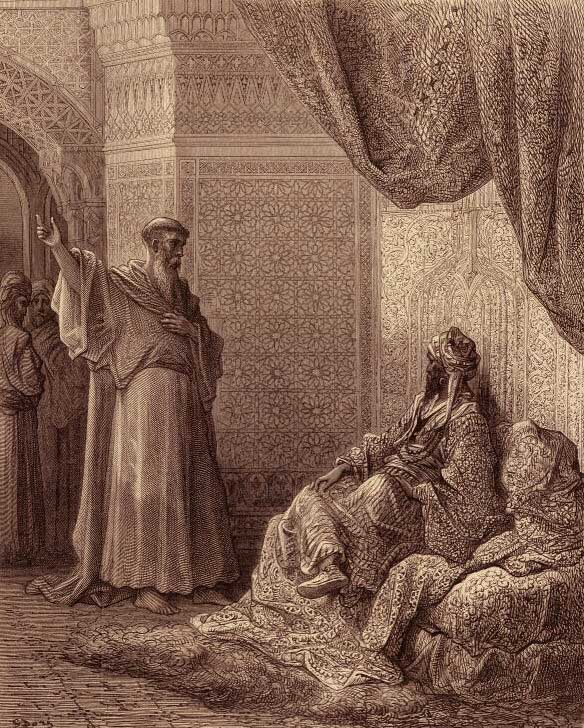
HOW ST FRANCIS CONVERTED TO THE FAITH THE SULTAN OF BABYLON


St Francis, urged by zeal for the faith of Christ and by a wish to suffer martyrdom, took with him one day twelve of his most holy brethren, and went beyond the sea with the intention of going straight to the Sultan of Babylon. They arrived in a province belonging to the Saracens, where all the passes were guarded by men so cruel, that no Christian who passed that way could escape being put to death. Now it pleased God that St Francis and his companions should not meet with the same fate; but they were taken prisoners, and after being bound and ill-treated, were led before the Sultan. Then St Francis standing before him, inspired by the Holy Spirit, preached most divinely the faith of Christ; and to prove the truth of what he said, professed himself ready to enter into the fire. Now the Sultan began to feel a great devotion towards him, both because of the constancy of his faith, and because he despised the things of this world (for he had refused to accept any of the presents which he had offered to him), and also because of his ardent wish to suffer martyrdom. From that moment he listened to him willingly, and begged him to come back often, giving both him and his companions leave to preach wheresoever they pleased; he likewise gave them a token of his protection, which would preserve them from all molestation.

At length St Francis, seeing he could do no more good in those parts, was warned by God to return with his brethren to the land of the faithful. Having assembled his companions, they went together to the Sultan to take leave of him. The Sultan said to him: “Brother Francis, most willingly would I be converted to the faith of Christ; but I fear to do so now, for if the people knew it, they would kill both me and thee and all thy companions. As thou mayest still do much good, and I have certain affairs of great importance to conclude, I will not at present be the cause of thy death and of mine. But teach me how I can be saved, and I am ready to do as thou shalt order.” On this St Francis made answer: “My lord, I will take leave of thee for the present; but after I have returned to my own country, when I shall be dead and gone to heaven, by the grace of God, I will send thee two of my friars, who will administer to thee the holy baptism of Christ, and thou shalt be saved, as the Lord Jesus has revealed to me; and thou in the meantime shalt free thyself from every hindrance, so that, when the grace of God arrives, thou mayest be found well disposed to faith and devotion.” The Sultan promised so to do; and did as he had promised. Then St Francis returned with his company of venerable and saintly brethren, and after a few years ending his mortal life, he gave up his soul to God. The Sultan, having fallen ill, awaited the fulfillment of the promise of St Francis, and placed guards in all the passes, ordering them if they met two brothers in the habit of St Francis to conduct them immediately to him. At the same time St Francis appeared to two of his friars, and ordered them without delay to go to the Sultan and save his soul, according to the promise he had made him. The two set out, and having crossed the sea, were conducted to the Sultan by the guards he had sent out to meet them. The Sultan, when he saw them arrive, rejoiced greatly, and exclaimed: “Now I know of a truth that God has sent his servants to save my soul, according to the promise which St Francis made me through divine revelation.” Having received the faith of Christ and holy baptism from the said friars, he was regenerated in the Lord Jesus Christ; and having died of his disease, his soul was saved, through the merits and prayers of St Francis.

[Public Domain.]


Sunday, June 11, 2006


CHAPTER XXIII:

'LITTLE FLOWERS' CONTINUED . . .


HOW ST FRANCIS DELIVERED THE BROTHER WHO, BEING IN SIN, HAD FALLEN INTO THE POWER OF THE DEVIL


St Francis, being one day in prayer in the Convent of the Portiuncula, saw, by the revelation of God, that all the convent was surrounded and besieged by devils, as by a great army; but none could penetrate into the convent, because the brothers were so holy that the demons could not enter into any of them. They remained, however, on the watch, until one day a certain brother being offended by another, thought in his heart how he could accuse and do him harm. Having yielded to this evil thought, the devil, seeing a way open to him, entered the convent and took possession of the brother. On this St Francis, like a vigilant pastor, ever watching over his flock, seeing the brother, and commanded him to confess immediately the hatred he had nourished in his heart towards his neighbour, which had caused him to fall into the power of the enemy. The brother, much alarmed, and seeing that his saintly father had penetrated into his deepest thoughts, confessed the evil feeling which had entered into his heart, and humbly asked pardon and penance. When he had done this, and being absolved of his sin had accepted his penance, St Francis beheld the devil to flee away; and the brother, being freed from such a cruel monster through the charity of his good shepherd, thanked God, and returned to the little flock of the saintly pastor corrected and strengthened, and lived afterwards in great sanctity.

[Public Domain.]


Saturday, June 10, 2006


ANGELS

I’ve been thinking: ‘We need ‘good angels’ so much in today’s world! I have a strong devotion to the angels, especially the Archangels and my own guardian angel. I’ve been praying the ‘Chaplet of St. Michael’ for over 30 years daily, the ‘Angelus’ three times a day, the ‘St. Michael the Archangel Exorcism Prayer’ and ‘Guardian Angel Prayer’ often. Has it helped me? I believe so. And not just to find a good parking spot!


Here are some definitions of who and what angels are:
First of all, the Catechism says that the existence of “angels” are a truth of faith. In other words, we are to believe in them! Who are they? Well St. Augustine says: “’Angel’ is the name of their office, not of their nature. If you seek the name of their nature, it is ’spirit’; if you seek the name of their office, it is ’angel’: from what they are, ’spirit,’ from what they do, ’angel.’
“With their whole beings the angels are servants and messengers of God. Because they “always behold the face of my Father who is in heaven” [Matt. 18:10] they are the “mighty ones who do His word, hearkening to the voice of His word” [Ps 103:20].


Pope Pius XII wrote: “As purely spiritual creatures angels have intelligence and will: they are personal and immortal creatures, surpassing in perfection all visible creatures, as the splendor of their glory bears witness” [Humani Generis].

No wonder we need their help, for we are so sinful and mortal, they are so pure and eternal!


All the angels belong to Jesus Christ, they are His angels: “When the Son of man comes in His glory, and all the angels with Him . . . [Matt. 25:31]; “for in Him all things were created in heaven and on earth, visible and invisible, whether thrones or dominions or principalities or authorities (some of the choirs of angels) -- all things were created through Him and for Him.” [Col. 1:16].


Now do you believe in angels? If not, let me know and I’ll try to help you in believing. St. Pio of Pietrelcina (Padre Pio) once said that there are more devils (bad angels) on earth today than man born! Imagine that! We certainly need the help of the ‘good angels’ in this supernatural war that is raging around us!


Mother Mary, Queen of Angels: Pray for us!


CHAPTER XXII:

'LITTLE FLOWERS' CONTINUED . . .


HOW ST FRANCIS TAMED THE WILD DOVES


A certain young man having caught one day a great number of doves, as he was to sell them he met St Francis, who always felt a great compassion for such gentle animals; and, looking at the doves with eyes of pity, he said to the young man: “O good man, I entreat thee to give me those harmless birds, emblems in Scripture of humble, pure, and faithful souls, so that they may not fall into cruel hands, which would put them to death.” And the young man, inspired by God, immediately gave them to St Francis, who, placing them in his bosom, addressed them thus sweetly: “O my little sisters the doves, so simple, so innocent, and so chaste, why did you allow yourselves to be caught? I will save you from death, and make your nests, that you may increase and multiply, according to the command of God.” Then St Francis made nests for them all, and they began to lay their eggs and hatch them in presence of the brethren, and were as familiar and as tame with St Francis and the friars as if they had been hens brought up amongst them, nor did they ever go away until St Francis had given them his blessing. Then said St Francis to the young man who had given them to him: “My son, thou shalt become a friar in this Order; and shalt serve most fervently the Lord Jesus Christ”; and so it came to pass, for the young man became a friar, and lived in the Order in great holiness.

[Public Domain.]


Friday, June 09, 2006


CHAPTER XXI:

'LITTLE FLOWERS' CONTINUED . . .


OF THE MOST HOLY MIRACLE OF ST FRANCIS IN TAMING THE FIERCE WOLF OF GUBBIO


At the time when St Francis was living in the city of Gubbio, a large wolf appeared in the neighbourhood, so terrible and so fierce, that he not only devoured other animals, but made a prey of men also; and since he often approached the town, all the people were in great alarm, and used to go about armed, as if going to battle. Notwithstanding these precautions, if any of the inhabitants ever met him alone, he was sure to be devoured, as all defence was useless: and, through fear of the wolf, they dared not go beyond the city walls. St Francis, feeling great compassion for the people of Gubbio, resolved to go and meet the wolf, though all advised him not to do so. Making the sign of the holy cross, and putting all his confidence in God, he went forth from the city, taking his brethren with him; but these fearing to go any further, St Francis bent his steps alone toward the spot where the wolf was known to be, while many people followed at a distance, and witnessed the miracle. The wolf, seeing all this multitude, ran towards St Francis with his jaws wide open. As he approached, the saint, making the sign of the cross, cried out: “Come hither, brother wolf; I command thee, in the name of Christ, neither to harm me nor anybody else.” Marvellous to tell, no sooner had St Francis made the sign of the cross, than the terrible wolf, closing his jaws, stopped running, and coming up to St Francis, lay down at his feet as meekly as a lamb. And the saint thus addressed him: “Brother wolf, thou hast done much evil in this land, destroying and killing the creatures of God without his permission; yea, not animals only hast thou destroyed, but thou hast even dared to devour men, made after the image of God; for which thing thou art worthy of being hanged like a robber and a murderer. All men cry out against thee, the dogs pursue thee, and all the inhabitants of this city are thy enemies; but I will make peace between them and thee, O brother wolf, is so be thou no more offend them, and they shall forgive thee all thy past offences, and neither men nor dogs shall pursue thee any more.” Having listened to these words, the wolf bowed his head, and, by the movements of his body, his tail, and his eyes, made signs that he agreed to what St Francis said. On this St Francis added: “As thou art willing to make this peace, I promise thee that thou shalt be fed every day by the inhabitants of this land so long as thou shalt live among them; thou shalt no longer suffer hunger, as it is hunger which has made thee do so much evil; but if I obtain all this for thee, thou must promise, on thy side, never again to attack any animal or any human being; dost thou make this promise?” Then the wolf, bowing his head, made a sign that he consented. Said St Francis again: “Brother wolf, wilt thou pledge thy faith that I may trust to this thy promise?” and putting out his hand he received the pledge of the wolf; for the latter lifted up his paw and placed it familiarly in the hand of St Francis, giving him thereby the only pledge which was in his power. Then said St Francis, addressing him again: “Brother wolf, I command thee, in the name of Christ, to follow me immediately, without hesitation or doubting, that we may go together to ratify this peace which we have concluded in the name of God”; and the wolf, obeying him, walked by his side as meekly as a lamb, to the great astonishment of all the people. Now, the news of this most wonderful miracle spreading quickly through the town, all the inhabitants, both men and women, small and great, young and old, flocked to the market-place to see St Francis and the wolf. All the people being assembled, the saint got up to preach, saying, amongst other things, how for our sins God permits such calamities, and how much greater and more dangerous are the flames of hell, which last for ever, than the rage of a wolf, which can kill the body only; and how much we ought to dread the jaws of hell, if the jaws of so small an animal as a wolf can make a whole city tremble through fear. The sermon being ended, St Francis added these words: “Listen my brethren: the wolf who is here before you has promised and pledged his faith that he consents to make peace with you all, and no more to offend you in aught, and you must promise to give him each day his necessary food; to which, if you consent, I promise in his name that he will most faithfully observe the compact.” Then all the people promised with one voice to feed the wolf to the end of his days; and St Francis, addressing the latter, said again: “And thou, brother wolf, dost thou promise to keep the compact, and never again to offend either man or beast, or any other creature?” And the wolf knelt down, bowing his head, and, by the motions of his tail and of his ears, endeavoured to show that he was willing, so far s was in his power, to hold to the compact. Then St Francis continued: “Brother wolf, as thou gavest me a pledge of this thy promise when we were outside the town, so now I will that thou renew it in the sight of all this people, and assure me that I have done well to promise in thy name”; and the wolf lifting up his paw placed it in the hand of St Francis. Now this event caused great joy in all the people, and a great devotion towards St Francis, both because of the novelty of the miracle, and because of the peace which had been concluded with the wolf; and they lifted up their voices to heaven, praising and blessing God, who had sent them St Francis, through whose merits they had been delivered from such a savage beast. The wolf lived two years at Gubbio; he went familiarly from door to door without harming anyone, and all the people received him courteously, feeding him with great pleasure, and no dog barked at him as he went about. At last, after two years, he died of old age, and the people of Gubbio mourned his loss greatly; for when they saw him going about so gently amongst them all, he reminded them of the virtue and sanctity of St Francis.

[Public Domain.]


Thursday, June 08, 2006


CHAPTER XX:

'LITTLE FLOWERS' CONTINUED . . .


OF A BEAUTIFUL VISION WHICH APPEARED TO A YOUNG MAN WHO HATED THE HABIT OF ST FRANCIS SO GREATLY, THAT HE WAS ON THE POINT OF LEAVING THE ORDER


A young man, of noble birth, and of delicate habits, who had entered the Order of St Francis, was seized after a few days, through the devil,s suggestions, with a violent dislike of the habit that he wore: he hated the shape of the sleeves; he felt a horror for the hood, for the length of the dress, and the coarseness of the material; so that it seemed to him as if he carried about him an insupportable weight; and, disliking the Order more and more, he determined to leave it and return to the world. It was the custom of this young man, at whatever hour he passed before the altar in the convent at which the Blessed Sacrament was reserved, to kneel down with great respect and, covering his head with his hood and crossing his arms on his breast, to prostrate himself, as he had been taught to do by the master of novices. It so happened, that the night when he had made up his mind to leave the convent, he passed before the altar, and, kneeling down as he was wont to do, he prostrated himself to the ground, and, being ravished in spirit, the Lord sent him a most wonderful vision. He saw before him a great multitude of saints ranged in procession, two by two, clothed in vestments made of precious material: their faces and their hands shone like the sun; they sang, as they walked, to the sound of celestial music. Two of them were more nobly and more richly dressed than the rest, and surrounded by such a blaze of light that none could look on them without being dazzled. At the end of the procession was one so gloriously adorned, that he seemed, like a new knight, to be more favoured than the others. Now the young man, seeing such a beautiful procession, was struck with wonder; but although he could not guess the meaning of the vision, he dared not ask, and seemed struck dumb with amazement. When the procession had almost passed away, he took courage, and addressing himself to those who were in the rear, he said: “O beloved, I pray you tell me who are those wonderful beings who form this venerable procession.” They answered: “Know, my son, that we are all Friars Minor, who are come from the glories of Paradise; and those two who shine forth brighter than the rest, are St Francis and St Anthony; and the last one you saw so especially honoured is a holy friar, lately dead, who having fought with courage against temptation and having preserved to the end, we lead in triumph to the glories of Paradise; and these splendid vestments which adorn us have been given to us by God, in exchange for the coarse tunic we wore with so much patience in religion; and the glorious light which shines upon us has been given in reward for the humility, the holy poverty, the obedience, and chastity that we observed to the end of our lives. Now, my son, do not find the robe of religion too rough to wear; for if, clothed in the sackcloth of St Francis, and out of love to Christ, thou dost despise the world, mortifying thy flesh, and fighting valiantly against the devil, thou too shalt receive these splendid vestments, and shine with this glorious light.” On hearing these words the young man came to his senses, and feeling himself much strengthened, he put far from him all temptation to leave the Order, confessed his sin to the guardian and to the brethren, and from that moment dearly loved the course vestment of St Francis and the severity of penance, and at length ended his life in the Order in a state of great sanctity.

[Public Domain.]


Wednesday, June 07, 2006


Statue of St. Francis of Assisi, St. Francis visitor center, Wild Oak vineyard

CHAPTER XIX:

'LITTLE FLOWERS' CONTINUED . . .


HOW THE VINE OF THE PRIEST OF RIETI, WHOSE HOUSE ST FRANCIS ENTERED TO PRAY, WAS TRAMPLED UNDER FOOT BY THE GREAT NUMBERS WHO CAME TO SEE HIM, AND HOW IT YET PRODUCED A GREATER QUANTITY OF WINE THAN USUAL, AS ST FRANCIS HAD PROMISED; AND HOW THE LORD REVEALED TO THE SAINT THAT HEAVEN WOULD BE HIS PORTION WHEN HE LEFT THIS WORLD


St Francis at one time being grievously tormented with a disease in his eyes, the Cardinal Ugolino, protector of his Order, who loved him dearly, wrote to him to come to Rieti, where there were excellent oculists. St Francis, having received the Cardinal’s letter, set off first to San Damiano, where was Sister Clare, the devout spouse of Christ, to give her some spiritual consolation, intending afterwards to go on to the Cardinal. On arriving at San Damiano, the following night his eyes grew so much worse that he could not see the light, and was obliged to give up going any further. Then Sister Clare made him a little cell of reeds, in order that he might repose the better; but St Francis, owing partly to the pain he suffered, and partly to the multitude of rats, which much annoyed him, could rest neither day or night. After suffering for several days this pain and tribulation, he began to think that it was sent to him by God as a punishment for his sins, and he thanked the Lord in his heart and with his lips, crying out with a loud voice: “My God, I am worthy of this, and even worse. My Lord Jesus Christ, thou Good Shepherd, who hast shown thy mercy to us poor sinners in the various bodily pains and sufferings it pleaseth thee to send us; grant to me, thy little lamb, that no pain, however great, no infirmity nor anguish, shall ever separate me from thee.” Having made this prayer, a voice came from heaven, which said: “Francis, if all the earth were of gold, if all the seas and all the fountains and all the rivers were of balm, if all mountains, all hills, and all rocks were made of precious stones, and if thou couldst find a treasure as much more precious again as gold is more precious than earth, and balm than water, and gems than mountains and rocks, if that precious treasure were offered to thee in the place of thy infirmity, wouldst thou not rejoice and be content?” St Francis answered: “Lord, I am unworthy of such a treasure.” And the voice of God said again: “Rejoice with all thy heart, Francis, for such a treasure is life eternal, which I have in keeping for thee, and even now promise to thee; and this thine infirmity and affliction is a pledge of that blessed treasure.” Then was St Francis filled with joy at so glorious a promise; and calling his companion, he said to him: “Let us go to the Cardinal.” He humbly took leave of Sister Clare, after having comforted her with holy words, and took the road to Rieti. When he approached the town, such a multitude came out to meet him, that he would not go into the city, but went to a church which was about two miles of. But the people, hearing where he was gone, went thither to see him; so that the vine which surrounded the church was greatly injured, and all the grapes were gathered; at which the priest, to whom it belonged, was very grieved in his heart, and repented of having received St Francis in his church. The thought of the priest being revealed to the saint, he called him to him and said: “Dearest father, tell me, how many measures of wine does this vine produce when the year is a fertile one?” He answered: “Twelve measures.” Then said St Francis: “I pray thee, father, have patience and endure my presence here a few days longer, as I find great rest in this church; and, for the love of God and of me his poor servant, let the people gather the grapes off thy vine; for I promise thee, in the name of my Saviour Jesus Christ, that it shall produce every year twenty measures of wine.” And St Francis remained there for the benefit of the souls of all who went to see him, for many went away filled with divine love, and gave up the world. The priest, having faith in the promise of St Francis, left the vineyard open to all those who came to see him. And, wonder of wonders! although the vine was entirely ruined, so that there scarcely remained, here and there, a few small bunches of grapes, when the time of vintage arrived, the priest gathered the few bunches which were left, and put them into the winepress; and according to the promise of St Francis, these few little bunches did not fail to produce twenty measures of excellent wine. This miracle teaches us that as, in consequence of the merits of St Francis, the vine, though despoiled of its grapes, produced an abundance of wine, so in the same way many Christians, whose sins had made them barren of virtue, through the saint’s preaching and merits, have often come to abound in the good fruit of repentance.

[Public Domain.]


Tuesday, June 06, 2006


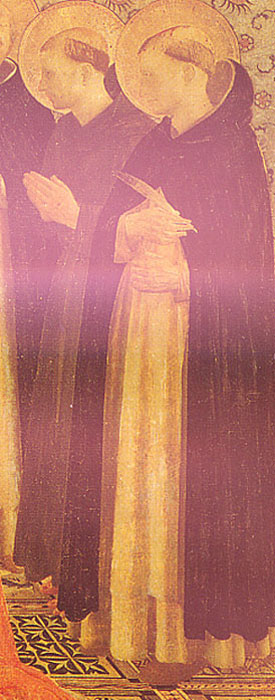
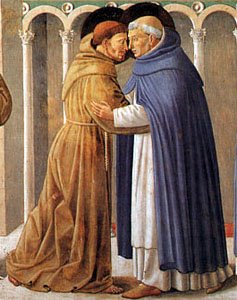
St. Francis & St. Dominic

CHAPTER XVIII:

'LITTLE FLOWERS' CONTINUED . . .


OF THE WONDERFUL CHAPTER HELD BY ST FRANCIS AT ST MARY OF THE ANGELS, AT WHICH MORE THAN FIVE THOUSAND FRIARS WERE PRESENT


The faithful servant of Christ, St Francis, once held a general chapter at St Mary of the Angels, at which chapter more than five thousand friars were present. Amongst them also was St Dominic, the head and founder of the Order of Friars Preachers, who chanced to be on his way from Bologna to Rome: for having heard of the chapter which St Francis had called together in the plain of St Mary of the Angels, he went there with seven friars of his Order. A certain Cardinal also, much devoted to St Francis, to whom the saint had foretold that he would one day be Pope, came expressly from Perugia to Assisi, and everyday he went to visit St Francis and his brethren. Sometimes he sang Mass and preached to them; and each time the said Cardinal visited the holy company he experienced much pleasure and devotion. Seeing the friars all seated in the plain round St Mary of the Angels, in groups - here forty, there a hundred, and elsewhere eighty, all occupied in conversing about God, or in prayer, or in works of charity - seeing them all so silent and so grave, and wondering how such a multitude could be so orderly, he was moved to tears, and exclaimed, with great devotion, “Truly this is the field of God; this is the army, and these are the knights of the Lord.” No vain or useless word was to be heard in all that multitude; each group of friars was engaged either in prayer, or saying their office, in weeping over their sins and those of their benefactors, or in reasoning on the salvation of souls. Many tents made of mats had been pitched in that field, divided in groups, according to the different provinces from whence the friars came; so that this Chapter was called the “Chapter of mats”.

The friars had no other beds but the bare ground, with here and there a little straw; for pillows they had stones or pieces of wood. For which reasons they were held in much devotion; and so great was the fame of their sanctity, that many came to see and hear them from the court of the Pope which was at Perugia, and from other parts of the Valley of Spoleto. Many counts and barons, many knights and other gentlemen, many Cardinals, Bishops and Abbots, many priests and much people, came to see this great and holy and humble congregation; for the world had never yet witnessed so many holy men assembled together; and most especially they went thither to see the saintly founder; and father of the Order, who had taken from the world so many gifted men, and had formed so beautiful and devout a flock to follow the steps of the true Pastor, Jesus Christ. The chapter being assembled, St Francis, the father of all those holy men, expounded with great fervour of spirit the Word of God, speaking to them in a loud voice that which the Holy Spirit dictated. Now the subject he took for his sermon was this: “My children, we have promised great things to God, and God has promised even greater things to us. If we observe what we have promised him, we shall certainly receive what he has promised to us. The pleasures of this world pass quickly away, but the punishment which follows them is eternal. The sufferings of this world are trifling, but the glory of the life to come is without bounds.” And, preaching on these words most devoutly, he comforted the brethren, encouraging them to holy obedience, to reverence for holy Mother Church, to charity among themselves, to pray God for all people, to bear with patience the adversities of life, to be temperate in prosperity, to keep angelic purity and chastity, to be at peace with God, with men and with their own conscience, to love, to observe, and to practise holy poverty. He then added: “I command you all here present, through holy obedience, to take no thought what you shall eat or what you shall drink, or of aught else that is necessary to the body, but only to meditate, to pray, and to praise God, casting on him the thought of all the rest, for he has you all in his especial care; and let each of you receive this command with a happy heart and a joyful countenance.” St Francis having finished his sermon, all the friars began to pray. Yet St Dominic, who was present, wondered much at this order of St Francis, considering it as indiscreet, for he could not understand how such a great multitude could exist without taking thought for the body. But the heavenly Pastor, our Blessed Saviour, wishing to show the care he takes of his lambs, and with what singular love he loves his poor servants, put into the hearts of all the people of Perugia, of Spoleto, of Foligno, of Spello, of Assisi, and of all the neighbouring country, to take meat and drink to that holy congregation; and presently men came from all these places with horses, and asses, and carts laden with bread and wine, with beans and cheese, and other good things of which the poor of Christ had need. Besides all this, they brought napkins and knives, jugs and glasses, and all that was needed for such a multitude; and those who could carry most and serve the best rejoiced greatly, and the knights, barons, and other noblemen, who were present, waited on the brethren with great devotion and humility. St Dominic, seeing this, and knowing of a certainty that it was the divine providence of God which had provided for them thus, acknowledged most humbly that he had unjustly accused St Francis of giving indiscreet orders; and going to him, he knelt humbly before him and confessed his fault, adding: “The Lord truly hath especial care of all these holy servants of poverty. I knew it not till now, and henceforth I promise to observe holy evangelical poverty; and, in the name of God, I condemn all friars of my Order who shall seek to have possessions of their own.” And St Dominic was greatly edified by the faith of the most holy Francis, by the obedience and poverty of so large and well-ordered a chapter, and he blessed the providence of God, who had given them every grace in such abundance. In that same chapter also it was revealed to St Francis that many brethren wore on their flesh small hearts and bands of iron, for which reason many were ill and hindered in their prayers; and St Francis, like a discreet father, gave order, under holy obedience, that all who wore such things should take them off and place them before him - and more than five hundred little hearts and bands of iron were placed before him - some destined to be worn round the arms, and others round the waist - and all together formed a large heap, which St Francis ordered to be left in that field. The chapter being ended, he encouraged them all in well-doing, warning them to avoid sin in this wicked world, and sent them to their divers provinces, with his blessing and that of God, filled with spiritual joy and consolation.

[Public Domain.]


Monday, June 05, 2006


June 2, 2006 Apparition to Mirjana Soldo
Dear Children of Medjugorje,
Praised be Jesus and Mary!

We do not always have the ability to share with you the content of Mirjana Soldo's monthly apparitions. However, we are blessed to be able to share with you Mirjana's description of her most recent visit from Our Lady on June 2, 2006.

Our Lady's monthly apparition to Mirjana Soldo on June 2, 2006:

After the Apparition Mirjana shared with us the following:

"Our Lady did not give a classical message. She blessed all of us who were present and all the religious articles that we brought with us for blessing.

With a serious expression on her face, Our Lady emphasized again the priestly blessing. With pain and love at the same time Our Lady said:

'Remember, children of mine, that it is my Son blessing you. Do not accept it so lightly'.

"After that Our Lady told me about some things that are supposed to happen and she said:

'There is no way without my Son. Do not think that you will have peace and joy if you do not have Him in the first place'."

Mirjana said: "I cannot say that Our Lady was sad or joyful; she was preoccupied, with loving care on her face."

We have also learned that Ivan was interviewed by Maria Dugandic on Radio Mir recently. Ivan was asked about what is going to happen ("some things that are supposed to happen", see Mirjana's words). Ivan said, "Yes, something is going to happen. I know what it is and when it is going to happen".

Sister Emmanuel +

Children Of Medjugorje, Inc.


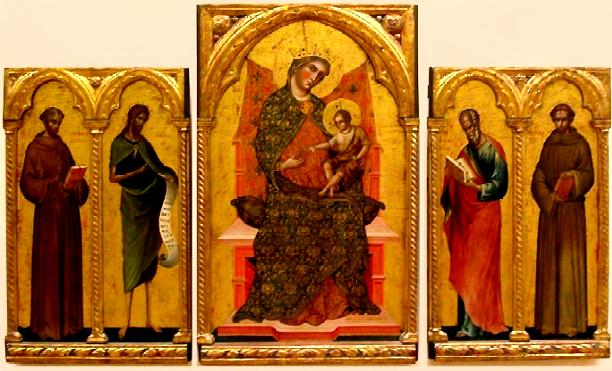
Domenico Veneziano, 1354

CHAPTER XVII:

'LITTLE FLOWERS' CONTINUED . . .


HOW A LITTLE CHILD WHO HAD ENTERED THE ORDER SAW ST FRANCIS IN PRAYER ONE NIGHT, AND SAW ALSO THE SAVIOUR, THE VIRGIN MARY, AND MANY OTHER SAINTS TALK WITH HIM


A certain pure and innocent child was received into the Order during the lifetime of St Francis, and the convent in which he lived was so small that the monks were obliged to sleep on mats. It chanced that St Francis came one day to that convent, and in the evening, after Compline, he went to rest, so as to rise up early to pray, as was his custom, when all the other friars were still asleep. The said little child had made up his mind carefully to watch St Francis, to learn something of his sanctity, and find out more especially what he did in the night when he got up; and in order that he might not be overtaken by sleep, he laid him down by St Francis, tying the end of the cord he wore round his waist to the one which the saint wore, so that he was sure of being awakened when the latter got up in the night; and this he did so gently, that St Francis was not aware of his contrivance. When all the other friars were fast asleep, St Francis rose from sleep, and finding the child’s cord tied to his own, he carefully untied it so as not to awake him and went alone into the wood which was near the convent. Entering into a little cell which was there, he began to pray. Shortly after, the child awoke, and finding St Francis gone, and the cord untied, he rose up quickly and went to seek him. Perceiving the door open which led to the wood, he thought St Francis had gone that way; and entering into the wood, and hurrying on to the little cell, he heard the sound of many voices. Approaching near to hear and see whence they came, he saw a great and wonderful light all round the saint, and in the light was Jesus Christ, with the Virgin Mary, St John the Baptist, St John the Evangelist, and a great multitude of angels, all talking with St Francis. On seeing this the child fell to the ground as if he had been dead. The miracle of this holy vision being ended, St Francis rose to return to the convent, and stumbling in the way against the child, who appeared to be dead, with great compassion he took him up in his arms and carried him in his bosom, as the good shepherd is wont to carry his lambs. Having learned from him how he had seen the vision, he forbade him to tell any man thereof so long as he, St Francis, lived. The little child grew up in the grace of God, and had a great devotion to St Francis. He became one of the most distinguished men of the Order. After the death of St Francis, he related the vision to the brethren.

[Public Domain.]


Sunday, June 04, 2006


CHAPTER XVI:

'LITTLE FLOWERS' CONTINUED . . .


HOW ST FRANCIS, HAVING BEEN TOLD BY ST CLARE AND THE HOLY BROTHER SILVESTER THAT HE SHOULD PREACH AND CONVERT MANY TO THE FAITH, FOUNDED THE THIRD ORDER, PREACHED TO THE BIRDS, AND REDUCED TO SILENCE THE SWALLOWS


The humble servant of Christ, St Francis, a short time after his conversion, having already assembled and received many brothers into the Order, was much troubled and perplexed in mind as to what he ought to do; whether to give himself entirely to prayer, or now and then to preach the Word. Through his great humility, he had no opinion of himself or of the virtue of his prayers; and, wishing to know the will of God, he sought to learn it through the prayers of others. Wherefore he called to him Brother Masseo, and thus addressed him: “Go to Sister Clare, and bid her from me to set herself with some of the holiest of her sisters to pray the Lord that he may show me clearly whether he wills that I should preach or only keep to prayer. Then go to Brother Silvester, and ask of him the same favour.” Now Brother Silvester had been in the world, and was the same who had seen in vision a golden cross come out of St Francis’s mouth, whose height reached up to heaven and its breadth to the farthest extremities of the world. Brother Silvester was so holy, that whatever he asked of God was granted to his prayer, and very often he held converse with the Lord; so that St Francis revered him greatly. Then Brother Masseo did as St Francis had commanded him; carrying the message first to St Clare, and then to Brother Silvester, who set about praying immediately; and, having received the answer from the Lord, returned to Brother Masseo, and said to him: “The Lord says, go and tell Brother Francis that he has called him to this state to save merely his own soul but that he may produce fruits in those of others, and that through him many souls be saved.” Having received this answer, Brother Messeo returned to Sister Clare, to ask what she had learnt from God; and she told him that she and all her companions had received from God the same answer as the Lord had given to Brother Silvester. Then Brother Masseo hastened to St Francis to bring him these answers; and St Francis received him with great charity, washing his feet, and serving him at dinner. When the repast was over, he called Brother Masseo into the forest, and, kneeling down before him, put back his hood; and crossing his arms on his breast, he said to him: “What answer dost thou bring me? what does my Lord Jesus Christ order me to do?” Brother Masseo answered: “The Lord Jesus Christ has revealed both to Brother Silvester and to Sister Clare, that it is his will thou shouldest go about the world to preach; for thou hast not been called for thyself alone, but the the salvation of others.” Then St Francis, having received the answer, and knowing it to be the will of the Lord Jesus Christ, arose with fervour, saying, “Let us go in the name of God”; and taking with him Brother Masseo and Brother Agnolo, both holy men, he let himself be guided by the Spirit of God, without considering the road he took. They soon arrived at a town called Savurniano, where St Francis began to preach, first ordering the swallows, who were calling, to keep silence until he had finished; and the swallows obeyed his voice. He preached with such fervour, that the inhabitants of the town wished to follow him out of devotion; but St Francis would not allow them, saying: “Be not in such haste, and leave not your homes. I will tell you what you must do to save your souls.” Thereupon he founded the Third Order for the salvation of all; and leaving them much consoled and well disposed to do penance, he departed thence, and reached a spot between Cannaio and Bevagno. And as he went on his way, with great fervour, St Francis lifted up his eyes, and saw on some trees by the wayside a great multitude of birds; and being much surprised, he said to his companions, “Wait for me here by the way, whilst I go and preach to my little sisters the birds”; and entering into the field, he began to preach to the birds which were on the ground, and suddenly all those also on the trees came round him, and all listened while St Francis preached to them, and did not fly away until he had given them his blessing. And Brother Masseo related afterwards to Brother James of Massa how St Francis went among them and even touched them with his garments, and how none of them moved. Now the substance of the sermon was this: “My little sisters the birds, ye owe much to God, your Creator, and ye ought to sing his praise at all times and in all places, because he has given you liberty to fly about into all places; and though ye neither spin nor sew, he has given you a twofold and a threefold clothing for yourselves and for your offspring. Two of all your species he sent into the Ark with Noe that you might not be lost to the world; besides which, he feeds you, though ye neither sow nor reap. He has given you fountains and rivers to quench your thirst, mountains and valleys in which to take refuge, and trees in which to build your nests; so that your Creator loves you much, having thus favoured you with such bounties. Beware, my little sisters, of the sin of ingratitude, and study always to give praise to God.” As he said these words, all the birds began to open their beaks, to stretch their necks, to spread their wings and reverently to bow their heads to the ground, endeavouring by their motions and by their songs to manifest their joy to St Francis. And the saint rejoiced with them. He wondered to see such a multitude of birds, and was charmed with their beautiful variety, with their attention and familiarity, for all which he devoutly gave thanks to the Creator. Having finished his sermon, St Francis made the sign of the cross, and gave them leave to fly away. Then all those birds rose up into the air, singing most sweetly; and, following the sign of the cross, which St Francis had made, they divided themselves into four companies. One company flew towards the east, another towards the west, one towards the south, and one towards the north; each company as it went singing most wonderfully; signifying thereby, that as St Francis, the bearer of the Cross of Christ, had preached to them and made upon them the sign of the cross, after which they had divided among themselves the four parts of the world, so the preaching of the Cross of Christ, renewed by St Francis, would be carried by him and by his brethren over all the world, and that the humble friars, like little birds, should posses nothing in this world, but should cast all the care of their lives on the providence of God.

[Public Domain.]

Saturday, June 03, 2006

Click to return to the main page

Click to return to the main page

May 31, 2006

SMITHSONIAN LINKED TO ANTI-CATHOLICISM

Catholic League president Bill Donohue wrote a letter today to the members of the House and Senate Appropriations Committees, the Board of Regents of the Smithsonian Institution, the Editor-in-Chief and Publisher of the Smithsonian magazine and the Secretary of the Smithsonian Institution. His letter, available here, concerns an article in the June edition of the Smithsonian by James Carroll titled, “Who Was Mary Magdalene?”

Donohue summarizes his position as follows:

“James Carroll has a long record of seeking to discredit the historical record of the Catholic Church so as to impugn its credibility today on issues that have little or nothing to do with his immediate subject. For example, in his book on the role of the Church during the Holocaust, he ends with a plea for the Church to change its teachings on women and sexuality. In his latest foray, he exploits and inflates the role of Mary Magdalene to accomplish the same ends. And he does so by treating Gnostic texts as if they carried the same historical weight as the New Testament. He also relies on two books that have been dismissed by serious students of history for their shoddy scholarship.

“Were it not for the source of Carroll’s commentary, all of this could be written off as interesting discourse, or the mere chatter of cynics. But the Smithsonian is not just another magazine: it is the flagship publication of the highly revered Smithsonian Institution, and thus carries the implicit imprimatur of the federal government.

“For the Smithsonian Institution to be associated with an article about Roman Catholicism that is written by a man who questions the Resurrection, the need for salvation and the divinity of Christ is reprehensible. It is obvious that anyone who would deny the heart and soul of Judaism or Islam would not find a receptive audience at the Smithsonian. What needs to be explained is why the same level of editorial scrutiny broke down in this instance.”

The Catholic League is the nation's largest Catholic civil rights organization. It defends individual Catholics and the institutional Church from defamation and discrimination.


CHAPTER XV:

'LITTLE FLOWERS' CONTINUED . . .


HOW ST CLARE ATE WITH ST FRANCIS AND HIS COMPANIONS AT ST MARY OF THE ANGELS


St Francis, when residing at Assisi, often visited St Clare, to give her holy counsel. And she, having a great desire to eat once with him, often begged him to grant her this request; but the saint would never allow her this consolation. His companions, therefore, being aware of the refusal of St Francis, and knowing how great was the wish of Sister Clare to eat with him, went to seek him, and thus addressed him: “Father, it seems to us that this severity on thy part in not granting so small a thing to Sister Clare, a virgin so holy and so dear to God, who merely asks for once to eat with thee, is not according to holy charity, especially if we consider how it was at thy preaching that she abandoned the riches and pomps of this words. Of a truth, if she were to ask of thee even a greater grace than this, thou shouldst grant it to thy spiritual daughter.” St Francis answered: “It seems to you, then, that I ought to grant her this request?” His companions made answer: “Yea, father, it is meet that thou grant her this favour and this consolation.” St Francis answered: “As you think so, let it be so, then; but, in order that she may be the more consoled, I will that the meal do take place in front of St Mary of the Angels, because, having been for so long time shut up in San Damiano, it will do her good to see the church of St Mary, wherein she took the veil, and was made a spouse of Christ. There, then, we will eat together in the name of God.” When the appointed day arrived, St Clare left her convent with great joy, taking with her one of her sisters, and followed by the companions of St Francis. She arrived at St Mary of the Angels, and having devoutly saluted the Virgin Mary, before whose altar her hair had been cut off, and she had received the veil, they conducted her to the convent, and showed her all over it. In the meantime St Francis prepared the meal on the bare ground, as was his custom. The hour of dinner being arrived, St Francis and St Clare, with one of the brethren of St Francis and the sister who had accompanied the saint, sat down together, all the other companions of St Francis seated humbly round them. When the first dish was served, St Francis began to speak of God so sweetly, so sublimely, and in a manner so wonderful, that the grace of God visited them abundantly, and all were rapt in Christ. Whilst they were thus rapt, with eyes and hearts raised to heaven, the people of Assisi and of Bettona, and all the country round about, saw St Mary of the Angels as it were on fire, with the convent and the woods adjoining. It seemed to them as if the church, the convent, and the woods were all enveloped in flames; and the inhabitants of Assisi hastened with great speed to put out the fire. On arriving at the convent, they found no fire; and entering within the gates they saw St Francis, St Clare, with all their companions, sitting round their humble meal, absorbed in contemplation; then knew they of a certainty, that what they had seen was a celestial fire, not a material one, which God miraculously had sent to bear witness to the divine flame of love which consumed the souls of those holy brethren and nuns; and they returned home with great consolation in their hearts, and much holy edification. After a long lapse of time, St Francis, St Clare, and their companions came back to themselves; and, being fully restored by the spiritual food, cared not to eat that which had been prepared for them; so that, the holy meal being finished, St Clare, well accompanied, returned to San Damiano, where the sisters received her with great joy, as they had feared that St Francis might have sent her to rule some other convent, as he had already sent St Agnes, the sister of the saint, to be Abbess of the Convent of Monticelli, at Florence. For St Francis had often said to St Clare, “Be ready, in case I send thee to some other convent”; and she, like a daughter of holy obedience, had answered, “Father, I am always ready to go whithersoever thou shalt send me.” For which reason the sisters greatly rejoiced when she returned to them, and St Clare was from that time much consoled.

[Public Domain.]


Friday, June 02, 2006


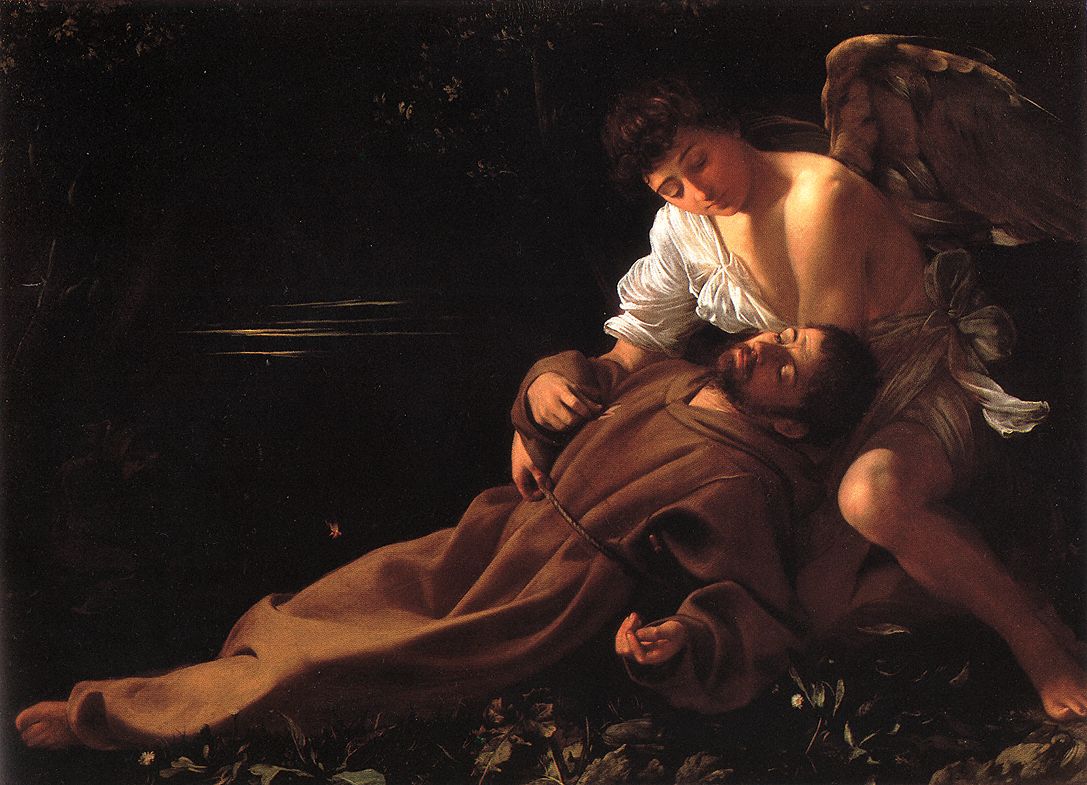
St. Francis in Ecstacy by Caravaggio


CHAPTER XIV:

'LITTLE FLOWERS' CONTINUED . . .


HOW THE LORD APPEARED TO ST FRANCIS AND TO HIS BRETHREN AS HE WAS SPEAKING WITH THEM


In the beginning of the Order, St Francis, having assembled his companions to speak to them of Christ, in a moment of great fervour of spirit commanded one of them, in the name of God, to open his mouth and speak as the Holy Spirit should inspire him. The brother, doing as he was ordered, spoke most wonderfully of God. Then St Francis bade him to be silent, and ordered another brother to speak in the same way, which having done with much penetration, St Francis ordered him likewise to be silent, and commanded a third brother to do the same. This one began to speak so deeply of the things of God, that St Francis was convinced that both he and his companion had spoken through the Holy Spirit. Of which also he received a manifest proof; for whilst they were thus speaking together, our Blessed Lord appeared in the midst of them, under the form of a beautiful young man, and blessed them all. And they, being ravished out of themselves, fell to the ground as if they had been dead, and were all unconscious of things external. And when they recovered from their trance, St Francis said to them: “My beloved brothers, let us thank God, who has deigned to reveal to the world, through his humble servants, the treasures of divine wisdom. For the Lord it is who openeth the mouth of the dumb, and maketh the tongues of the simple to speak wisdom.”

[Public Domain.]


Thursday, June 01, 2006

Mary leads always to Jesus Pope reminds


The Holy Father, Pope Benedict XVI, marked the end of the month of May yesterday evening, participating in a traditional Marian procession. The procession, which wound its way from the Church of St. Stephen of the Abyssinians - located near the apse of the Vatican Basilica – finished at the Grotto of Lourdes in the Vatican Gardens. Hundreds of people participated in the ceremony, which was presided over by Archbishop Angelo Comastri, vicar general for the Vatican City State.

Wednesday being the Feast of the Visitation of Mary to her cousin Elizabeth, the Holy Father spoke of the importance of Christ as the source of all Marian devotion. The Holy Father highlighted how in the Virgin Mary's visit "the hidden protagonist is Jesus. Mary carried Him in her womb as in a sacred tabernacle. ... Wherever Mary goes, there is Jesus."

"May true Marian devotion never obscure or diminish faith and love for Jesus Christ, our Savior, the only mediator between God and man. ... Let us, then, entrust ourselves to her with filial devotion,” the Holy Father said.


Yes, dear Holy Father, that's what I found in my life. As my love and devotion to Mary, our Mother grew, so did my love of Jesus, especially in the Most Blessed Sacrament! And now She is leading me to the Father and the Holy Spirit to complete my love for the Most Holy Trinity!


"Oh Most Holy Trinity, I adore Thee; My God, my God, I love Thee in the Most Blessed Sacrament!" (Fatima Prayer)


Jesus, the God-man, truly Present in the tabernacle of Mary's womb; Jesus, the God-man, truly Present in all the tabernacles of the world!

Jesus, the God-man, truly Present on the altar of the arms of the Blessed Virgin Mary in Bethlehem; Jesus, the God-man, truly Present in the hands of the priest at the altar in all our Catholic churches!


'Most Holy Trinity, Father, Son, and Holy Spirit I adore Thee profoundly, and I offer Thee the Most Precious Body, Blood, Soul and Divinity of Jesus Christ Present in all the tabernacles of the world, in reparation for the offences, sacriledges, and indifference by which He is offended. By the infinite merits of the Sacred Heart of Jesus, and the Immaculate Heart of Mary, I beg the conversion of poor sinners.' (Fatima Prayer)


CHAPTER XIII:

'LITTLE FLOWERS' CONTINUED . . .


HOW ST FRANCIS AND BROTHER MASSEO PLACED THE BREAD THEY HAD BEGGED UPON A STONE NEAR A FOUNTAIN, AND HOW ST FRANCIS PRAISED THE VIRTUE OF HOLY POVERTY, PRAYING ST PETER AND ST PAUL TO MAKE HIM LOVE HOLY POVERTY GREATLY, AND HOW ST PETER AND ST PAUL APPEARED TO HIM


The wonderful servant and follower of Christ, St Francis, wishing to be in all things conformed to his Master - who, as the Gospel tells, sent his disciples two by two into all the cities and lands whither he intended to go to prepare the way for him - after he had assembled his twelve companions, sent them forth two by two into the world to preach. In order to set them an example of holy obedience, he first began to act himself like the Saviour Jesus Christ. Wherefore, having sent his companions to divers parts of the world, he took with him Brother Masseo, and set out towards the province of France. On arriving in a certain town, being very hungry, they went, according to the Rule, begging their bread for the love of God. St Francis took one street, and Brother Masseo the other. St Francis, being a little man, with a mean exterior, did not attract much attention, and gathered only a few bits of dry bread, whereas Brother Masseo, being tall and good-looking, received many large pieces of bread, with several whole loaves. When they had ended their task of begging, they met on a spot outside the city where there was a beautiful fountain and a large stone, on which each placed what he had collected. St Francis, seeing that the pieces of bread which Brother Messeo had collected were much larger and better than those he had received, rejoiced greatly, and said: “O Brother Masseo, we are not worthy of this great treasure”; and he repeated these words several times. At this Brother Masseo answered: “Father, how canst thou talk of a treasure where there is so much poverty, and indeed a lack of all things? for we have neither cloth, nor knife, nor dish, nor table, nor house to eat in, nor servant or maid to wait upon us.” St Francis answered: “This is indeed the reason why I account it a great treasure, because man has had on hand in it, but all has been given to us by divine Providence, as we clearly see in this bread of charity, this beautiful table of stone, and this so clear fountain. Wherefore let us beg of God to make us love with all our hearts the treasure of holy poverty.” Having spoken thus, they returned thanks; and when they had refreshed themselves with the bread and water, they rose and went on their way to France. And meeting with a church on the road, St Francis said to his companion, “Let us enter this church and pray.” And entering in, St Francis cast himself down in prayer before the altar, and during his prayer the Lord visited him with a great increase of fervour, which so inflamed his soul with affection for holy poverty, that it seemed as if flames played around his head, and preceeded from his mouth; and going thus, all shining and burning with divine love, to his companion, he said to him, “Ah! ah! ah! Brother Masseo, give thyself to me”; and these words he repeated three times. At the third time he breathed on Brother Masseo, who, to his great surprise, was raised above the earth, and fell at some distance before the saint. He told his companion afterwards that, while thus raised in the air, he had felt such a sweet sensation in his soul, and had received such consolations from the Holy Spirit, as he had never before experienced. After this St Francis said to his companion: “Let us go to St Peter and St Paul, and let us pray them together that they may teach us and help us to possess the unbounded treasure of holy poverty, for it is a treasure so great and so divine, that we are not worthy to possess it in these vile bodies of ours. It is this celestial virtue which teaches us to despise all earthly and transitory things, and through it every hindrance is removed from the soul, so that it can freely commune with God. Through this virtue it is that the soul, while still on earth, is able to converse with the angels in heaven. This virtue it is which remained with Christ upon the Cross, was buried with Christ, rose again with Christ, and with Christ went up into heaven. This virtue it is which even in this world enables the souls who are inflamed with love of him to fly up to heaven; it is also the guardian of true charity and humility. Let us then pray the holy Apostles of Christ, who were perfect lovers of this evangelical pearl, to obtain for us from the Saviour Jesus the grace, through his great mercy, to become true lovers, strict observers, and humble disciples of this most precious, most beloved, and most evangelical grace of poverty.” And thus conversing they arrived at Rome, and entered the church of St Peter, where St Francis knelt in prayer in one corner and Brother Masseo in another. After praying for some time with great devotion and many tears, the most holy Apostles Peter and Paul appeared to St Francis in much splendour, and thus addressed him: “As thy prayer and thy wish is to observe that which Christ and his holy Apostles observed, the Lord Jesus sends us to thee, to tell thee that thy prayer has been heard, and that it is granted to thee and to all thy followers to possess the treasure of holy poverty. We tell thee also from him, that whosoever, after thy example, shall embrace this holy virtue, shall most certainly enjoy perfect happiness in heaven; for thou and all thy followers shall be blessed by God.” Having said these words they disappeared, leaving St Francis full of consolation. Then rising from prayer, and returning to Brother Masseo, he asked him if God had revealed anything to him in prayer. He answered, “No.” Then St Francis told him how the holy Apostles had appeared to him, and what they had said. And both being filled with joy, they resolved to return to the Valley of Spoleto, giving up the journey into France.

[Public Domain.]