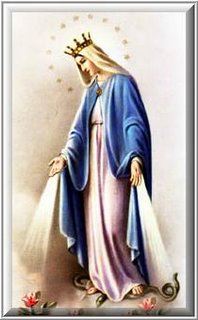
From all eternity Father, Son, and Holy Spirit chose Mary to be the Mother of the Word Incarnate. It was unthinkable that she be defiled by sin, in any way or for the least second of time. Therefore, in the instant of creating Mary's person, the Trinity made her Immaculate. This grace, like every other grace granted since the fall of Adam, was given her through the merits of Christ. She was truly saved, redeemed, not from an evil already present, but from an evil that threatened.
In honor of the Immaculate Conception, celebrated today throughout the world in all Roman Catholic Churches, I'm posting this poem by St. Therese of Lisieux, the Little Flower of Jesus. This was her last poem she wrote!
Photograph taken by St Thérèse’s sister Céline on the date of her
death. Behind her body is the statue of Our Lady of the Smile that St
Thérèse loved and which smiled at her and cured her during the terrible
illness at the age of 10:
WHY I LOVE THEE MARY.
LAST POEM OF SISTER TERESA.
Fain would I sing, O Mother blest! the reasons why I love thee;
Why e’en to name thy name, with joy, O Mary! fills my heart;
And why the glorious thoughts of thee, in greatness far above me,
Inspire no fear within my soul, so dear and sweet thou art.
Yet, if I were to see thee now, in majesty stupendous,
Surpassing all the crowned saints in highest heaven above,
Scarce could I dream I am thy child, (O truth sublime, tremendous!),
For I should think myself to be unworthy of thy love.
The mother, who desires to be her child’s best earthly treasure,
Must ever share its grief with it, must understand its pain.
Queen of my heart! how many years, thy sorrows had no measure;
What bitter tears thine eyes have shed, my worthless heart to gain!
So, musing on thy earthly life, in Scripture’s sacred story,
I dare to look upon thy face, and unto thee draw nigh;
For when I see thee suffering, — concealed thy marvelous glory —
It is not hard, then, to believe thy little child am I.
When Gabriel came from heaven’s courts, to ask thee to be mother
Of God Who reigns omnipotent to all eternity,
I see thee, Mary! then prefer to that great grace, another, —
Through all thy consecrated life a virgin pure to be.
And so I now can comprehend, immaculate white maiden!
Why thou wast dearer unto God than heaven itself could be;
And how thy humble, human frame, with mortal weakness laden,
Could yet contain the Eternal Word, Love’s vast unbounded Sea.
I love thee when I hear thee call thyself the handmaid only
Of God, Whom thou didst win to earth by thy humility;
All-powerful it made thee then, above all women, lonely,
And drew, into thy bosom chaste, the Blessed Trinity,
The Holy Spirit, Love Divine, o’ershadowed thee, O Mother!
And God the Father’s only Son incarnate was in thee.
How many sinful, sorrowing souls shall dare to call Him — Brother!
For He shall be called: Jesus, thy first-born, eternally.
And oh! despite my frailties, dear Mary! well thou knowest
That I at times, like thee, possess the Almighty in my breast.
Shall I not tremble at the gift, O God! that Thou bestowest ?
A mother’s treasure is her child’s: — I still my fears to rest.
For I, O Mary, am thy child! O Mother dear and tender.
Shall not thy virtues and thy love plead now with God for me?
Then, when the pure white sacred Host, in all its veiled splendor,
Visits my heart, thy spotless Lamb will think He comes to thee.
Oh, thou dost help me to believe that e’en for us, frail mortals,
‘Tis not impossible to walk where we thy footsteps see;
The narrow road before us now, thou lightest to heaven’s portals.
Who lowliest virtues here below didst practise perfectly.
Near thee, O Mother! I would stay, little, unknown and lowly;
Of earthly glory, oh! how plain I see the vanity!
In the house of St. Elizabeth, thy cousin dear and holy,
I learn of thee to practise well most ardent charity.
There, too, I listen on my knees, great Queen of all the Angels!
To that sweet canticle that flows in rapture from thy soul;
So dost thou teach me how to sing like heavenly, glad evangels
And glorify my Jesus, Who alone can make me whole.
Thy burning words of love divine are mystic flowers victorious,
Whose fragrance shall embalm the long, long, ages yet to be.
In thee, indeed, the Almighty King hath done great things and glorious!
I meditate upon them now, and bless my God in thee.
When good St. Joseph did not know the great archangel’s story,
Which thou wouldst fain conceal from men in thy humility,
O tabernacle of the Lord! thou didst not tell thy glory,
But veiled the Saviour’s presence in profoundest secrecy,
Thy silence, how I love it now, so eloquent, so moving!
For me it is a concert sweet, of melody sublime;
I learn thereby the grandeur of a soul that God is proving,
That only looks for help from Him and in His chosen time.
Then later still, O Joseph! and O Mary! I behold you
Repulsed in little Bethlehem by all the dwellers there;
From door to door you vainly went, for all the people told you
They had no place to shelter you, no time to give you care.
Their rooms were for the great alone; and in a stable dreary
The Queen of Heaven gave birth to Him Who made both heaven and earth.
O Mother of my Saviour! then, thou wast not sad nor weary;
In that poor shed how grand thou wert! how painless was that Birth!
And there when, wrapped in swaddling bands, I see the King Eternal, —
When of the Word divine, supreme, the feeble cry I hear —
O Mary, can I envy e’en the angels’ joy supernal?
The Master Whom they worship is My little Brother dear.
What praises must I give to thee, who, in earth’s gloomy prison,
Brought forth this lovely heaven-sent Flower, before our eyes to bloom!
Though unto shepherds and wise men a star had grandly risen,
These things were kept within thy heart as in some secret room.
I love thee when I see thee next, like other Hebrew women,
To Israel’s temple turn thy steps when dawned the fortieth day;
I love thee yielding humbly up, to aged, favored Simeon,
The Lord Who should redeem us all when years had fled away.
And first my happy smiles awake, to hear his glorious singing, —
That “Nunc Dimittis” that shall ring till Time itself shall die;
But soon those joyous notes are changed, and my hot tears are springing; —
“A sword of grief must be thy lot,” thus runs his prophecy.
O Queen of all the martyr-host! till thy life here is ended,
That sharp, sharp sword shall pierce thy heart! At once, it pierces sore.
That thy dear Child from Herod’s wrath may surely be defended,
I see thee as an exile fled to Egypt’s pagan shore.
Beneath thy veil thy Jesus slept, thy peace no fears were daunting,
When Joseph came to bid thee wake, and straightway flee from home;
And then at once I see thee rise, as called by angels chanting,
Content, without a questioning word, in foreign lands to roam.
In Egypt and in poverty, I think I see thee, Mary,
All glad at heart, all radiant, with joy beyond compare.
What matters exile unto thee? Thy true home cannot vary.
Hast thou not Jesus, with thee still? and with Him Heaven is there.
But, oh! in fair Jerusalem, a sorrow, vast, unbounded,
Indeed o’erwhelmed thy mother-heart with grief beyond compare; —
For three days Jesus hid Himself; no word to thee was spoken.
Thou truly wast an exile then, and knew what exiles bear.
And when, at last, thine eyes again were thy Son’s face beholding,
And love entranced thee, watching Him among the doctors wise.
My Child!” thou saidst, “now tell me why didst leave my arms enfolding?
Didst Thou not know we sought for Thee with tear-endimmed eyes?
The Child-God answered to thee then, to thy sweet, patient wooing,
O Mother whom He loved so well, whose heart was well-nigh broken!
“How is it that you sought for Me? Wist not I must be doing
My Father’s work?” Oh, who shall sound the depths those words betoken?
But next the Gospel tells me that, in His hidden mission,
Subject to Joseph and to thee was Christ, the Holy Boy;
And then my heart reveals to me how true was His submission,
And how beyond all words to tell, thy daily, perfect joy.
And now the temple’s mystery I understand, dear Mother!
The answer, and the tone of voice, of Christ, my King adored.
‘Twas meant the pattern thou shouldst be, thereafter to all other
Tried souls who seek, in Faith’s dark night the coming of the Lord.
Since Heaven’s high King has willed it so His Mother and His dearest
Should know the anguish of that night the torn heart’s deepest woe,
Then are not those, who suffer thus, to Mary’s heart the nearest?
And is not love in suffering God’s highest gift below?
All, all that He has granted me, oh! tell Him He may take it!
Tell Him, dear Mother! He may do whate’er He please with me;
That He may bruise my heart to-day, and make it sore, and break it,
So only through Eternity my eyes His Face may see!
I know, indeed, at Nazareth, O Virgin rich in graces!
As the lowly live, so thou didst live, and sought no better things;
Of ecstasies and wonders there, our eyes can find no traces,
O thou who daily dwelt beside the incarnate King of Kings!
On earth, we know, is very great the number of the lowly;
With neither fear nor trembling now we dare to look on thee.
By common lot and humble path, our Mother dear and holy,
Thou wast content to walk to heaven, and thus our guide to be.
Through all my weary exile here, I fain would walk beside thee.
O my pure and precious Mother! be near to me each day!
Thy beauty thrills my heart with joy. Deign now to guard and guide me!
What depths of love are in thy heart for me thy child, alway!
Before thy kind maternal glance, my many fears are banished;
Thou teachest me to gently weep, and then to sing for joy;
Thou dost not scorn our happy days, nor hast thou wholly vanished;
Thou smilest on us tenderly, as once upon thy Boy!
When bride and groom at Cana’s feast knew well the wine was failing,
And knew not whence to bring supply, their need thine eyes perceived,
To Christ, the Master, thou didst speak, who knew His power availing, —
The Maker of created things, in Whom thy soul believed.
But first He seemed thy mother-heart’s kind prayer to be denying.
“What matters this, O woman! unto Me and thee?” said He.
But “Mother,” in His soul’s deep depths, His filial heart was crying;
And that first miracle He wrought, Mother, lie wrought for thee.
One day, while sinners crowded round to hear what He was saying,
In His desire to save their souls and them to heaven beguile,
Lo! thou wast there amid the throng, and thou wast meekly praying
That they would let thee nearer come, and speak with Him awhile.
And then thy Son spoke out this word mysterious like that other.
To show us thus His marvelous love for all the souls of men; —
He said: “Who is My brother, and My sister, and My Mother?
‘Tis he who does My Father’s will!” The Father’s will, again!
O Virgin, pure, immaculate! O Mother, tenderest, dearest!
Hearing these words that Jesus spake, this time thou wast not grieved.
No! thy great heart it leaped for joy, O thou His friend the nearest!
Because our longing souls likewise to kinship He received.
Oh, how thy heart is glad to know His love to us is given, —
The treasure, that cannot be weighed, of His Divinity!
Who shall not love thee well to-day, and bless thee in high heaven,
Seeing thy tender care for us, thy generosity!
For truly thou dost love us all as thy Child Jesus loves us;
And for our sake thou didst consent to stay when He had risen.
Since, if we love, then all to give, e’en self, both tries and proves us,
So thou, to prove thy love, didst stay in earth’s dark, dreary prison.
Thy love for souls our Saviour knew, that love His heart had sounded;
He left thee to us when He went to God’s right hand on high.
Refuge of sinners! on thy prayers how many hopes are grounded!
Christ gave thee to us from His cross; for us He hears thy cry.
For thou — His Mother — there didst stand, that awful day, on Calvary;
As a priest before God’s altar, at the cross so thou didst stand.
And to appease the Father’s wrath, didst offer up, O Mary!
Thy Jesus, our Emmanuel, at God’s supreme command.
A prophet had foretold this thing, O Mother brokenhearted!
“Is any sorrow like to thine?” Thy grief no words can say!
Blest Queen of martyrs! left on earth when Jesus had departed!
‘Twas thy heart’s blood for us was given on that unequalled day.
Henceforth thy shelter in thy woe was St. John’s humble dwelling;
The son of Zebedee replaced the Son Whom heaven adored.
Naught else the Gospels tell us of thy life, in grace excelling;
It is the last they say of thee, sweet Mother of my Lord!
But that deep silence, oh! I think it means that, up in glory,
When time is past, and into heaven thy children safe are come,
The Eternal Word, my Mother dear, Himself will tell thy story,
To charm our souls, thy children’s souls, in our eternal home.
Soon I shall hear that harmony, that blissful, wondrous singing;
Soon, soon, to heaven that waits for us, my soul shall swiftly fly.
O Thou who cam’st to smile on me at dawn of life’s beginning!
Come once again to smile on me. . . . Mother! the night is nigh.
I fear no more thy majesty, so far, so far above me,
For, I have suffered sore with thee; now hear my heart’s deep cry!
Oh! let me tell thee face to face, dear Virgin! how I love thee;
And say to thee forevermore: thy little child am I.
May,1897.
Public Domain.


 Let’s pray together


