Thursday, September 07, 2006


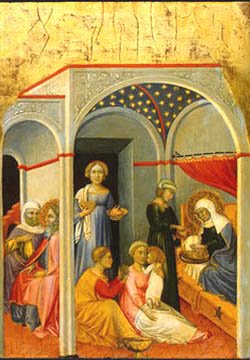
The Nativity of Our Lady
by Andrea di Bartolo


THE NATIVITY OF THE BLESSED VIRGIN MARY

"For she is more beautiful than the sun, and above all the order of the stars: being compared with the light, she is found before it." (Wisdom 7: 29)

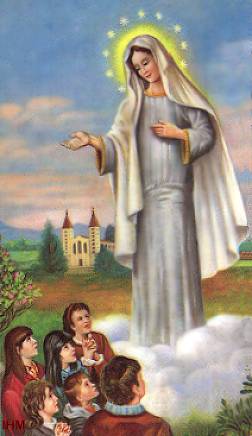
There's a wonderful story in Jan Connell's book "Visions of the Children": In the first few days of the Apparitions, the Blessed Mother was most gracious about the fear of the six visionaries, and gentle about the personal suffering each was enduring. She told the Children: “Would you Children like to give me some presents?” [To celebrate Her Birthday] Jacov sorrowfully blurted, “Dear Blessed Mother, I don’t have any money!” The Blessed Mother smiled joyfully and said: “Oh Jacov, my dearest little one, you don’t need money for my birthday presents! Tonight when you go home, no matter what your feelings tell you, no matter how you are stimulated, rather than speak the pain in your heart, run outside and look at the heavens and cry out, ‘Its all for the love of you, Dear Jesus.’”

Mirjana said the next evening at the Apparition, the Blessed Mother thanked Jacov for his gifts from the previous evening. By the time the Blessed Mother’s birthday arrived, Mirjana said that Jacov “was just bursting”. He had billions of presents for the Blessed Mother! High-strung and nervous by nature, young Jacov could hardly contain himself during the long rosary prayers that preceded the Apparition. Finally the moment came. The great flashes of light announced the arrival of the Queen of Heaven and Earth. As Jacov saw her he literally reached up and grabbed at the Mother of God as he cried out. “Happy Birthday, Dear Blessed Mother!” Realising what he had done, Jacov fell on the floor in shame and fear. Mirjana said she saw the Blessed Mother tenderly lean down and pick him up as she took his little nail-bitten hand in hers and kissed it.


Are we remembering that our Mother Mary's birthday is celebrated by the Church throughout the world on September 8th? Are we planning to give her a present too? Have we already picked a present that will please her? Have we some way to give it to Her?

All mothers are alike. When you were a young child, didn't your mother give you the money to buy her a present? The Mother of us all will be glad to pay for the present we wish to give Her, and she will enjoy it!

Why not give Her some gems and jewels? We say you can't afford such a gift. We can. We can give Her the jewel of modesty: purity of thought and word and action; these are precious gems; but we have to beg them from our Blessed Mother. Let us ask Her to give them to us so that, in turn, we can give them to Her as a gift on Her birthday.

Us parents; God has given us our children as precious gifts, why not offer them to Mother Mary on Her birthday, She will mold them into images of Jesus and Herslf; and make them Saints. I do this every day with my prayers saying: "I bind my children to the Immaculate Heart of Mary." When my daughter Elizabeth was baptized, we asked the priest to consecrate her to Mother Mary. He took us to a side altar of Our Lady and before her statue consecrated Elizabeth to Mary's Immaculate Heart. Whatever happens, I know that Our Lady will take care of my children's souls and lead them to heaven. Our Mother promises this, so never give up on your children!

Some other gifts that we could give to Our Blessed Mother are:

A handkerchief for Her tears; uniting our own tears of sorrow, disappointment, pain, and misunderstanding with Our Lady's Sorrowful and Immaculate Heart caused by the sins of the world.

A charming dress called humility, asking Mother Mary to give us the material we need to make us humble, modeled after her deep humility.

A pair of gloves; gloves for our hands that we used to do works of charity, deeds of kindness, love and devotion; Good Works! How She will love this gift!

Flowers. Mary loves flowers. She has asked us to adorn the Tabernacles where Her Dear Son, Jesus, waits for us to adore His True Presence, with flowers and candles. And praying the garland of flowers, the circlet of roses, the Holy Rosary, is a special gift from God the Father for Mother Mary; a gift we can present to Her every day of our lives!
And finally, the best gift of all! Holy Mass and Holy Communion! Why not be there on September 8th, to honor Our Lady's Birthday and present all these gifts to her in person. She is always present at Mass, just like She stood at the foot of the Cross at Calvary. She will always be next to Her Divine Son, Jesus, interceding for us from the moment we are born to the moment we die!


Happy Birthday, Mother Mary!
Deacon John

Sunday, September 03, 2006


CHAPTER XVIII, BOOK IV,

'LITTLE FLOWERS'


OF THE REMEMBRANCE OF DEATH


If a man had ever before the eyes of his mind the remembrance of death and of the final eternal judgment, and of the pains and torments of the lost souls, certain it is that he would never have a will to sin or to offend God. And if it were possible for a man to have lived from the beginning of the world until now, and in all that time to have endured every kind of adversity, tribulation, grief, sorrow and affliction, and so to die, and then his soul go to receive the eternal bliss of heaven, what harm would he have received from all the evil which he had endured during all that time past?

Again, if for the same space of time a man had enjoyed every king of earthly pleasure and consolation, and then, when he came to die, his soul were to fall into the eternal torments of hell, what would all the good things profit him which he had enjoyed in the time past?

A begger man said once to Brother Giles: “I tell thee, I would right gladly live a long time in this world, and have great riches and abundance of all things, and be held in great honour.” To whom Brother Giles made answer: “My brother, wert thou to be lord of the whole world, and wert thou to live therein a thousand years in every kind of temporal enjoyment, pleasure, delight and consolation, tell me, what guerdon or what reward couldst thou look for from this miserable flesh of thine, which thou wouldst so diligently serve and cherish? But I say to thee, that he who lives according to the will of God, and carefully keeps himself from offending God, shall receive from God, the Supreme Good, and infinite eternal reward, great and abundant riches and great honour, and long eternal life in that perpetual celestial glory; unto which may our good God, Lord, and King, Jesus Christ, bring us all, to the honour of the same Lord Jesus Christ, and of his poor little one Francis.”

[Public Domain.]

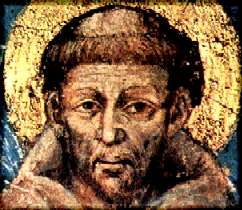
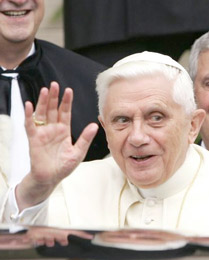
And so ends the book "The Little Flowers of St. Francis." I hope everyone enjoyed reading it chapter by chapter. I certainly enjoyed posting it for you! The Holy Father, Pope Benedict had a few words to say about St. Francis the other day:

The Pope met with the priests in the Swiss Hall of his summer residence at Castelgandolfo.

According to Italian news agency ANSA, the Holy Father told the men that they should use the conversion story of St. Francis of Assisi as an example for young people in their diocese.

The Pope stressed that the young Saint’s conversion is his real significance for the Catholic Church.

Francis (1181-1226) was the son of a well-to-do merchant in the town of Assisi. Historians say that as a young man he lived a carefree and irresponsible life focused on pursuing the ideals of his day.

Young Francis was drawn by the “glamour” of the military life, but underwent a dramatic conversion during a year he spent as a prisoner of war in Perugia. Upon his return to Assisi he witnessed the terrible conditions in which beggars and lepers in his own city lived and renounced his former life.

Francis left his wealthy home to live as a hermit and devoted himself to looking after the sick and rebuilding decaying churches around Assisi. In 1209 he decided to live in total poverty and to spend his time preaching.

"First he was sort of playboy but then he felt that this was no longer sufficient," Benedict continued, according to ANSA.

Pope Benedict said the story was one which could "animate the young" and inspire them embrace the Church.

He also lamented that St. Francis name is sometimes "exploited" by being associated with political ideologies, apart from his Catholic message.

The Pontiff was apparently referring to a tendency by environmentalists and pacifists to evoke the medieval saint, who founded the Franciscan order of friars, as a champion of their causes. Francis, the Pontiff reportedly said, "was above all a convert."


God Bless Us All!
Deacon John


Saturday, September 02, 2006


Below is a link to an important article written by the former pastor of St. James Parish at Medjugorje.
Please consider distributing this article as widely as possible.
Fr Tomislav Pervan, OFM, speaks on Medjugorje


CHAPTER XVII, BOOK IV,

'LITTLE FLOWERS'


OF HOLY OBEDIENCE


The more strictly a Religious holds himself bound by the yoke of holy obedience for the love of God, the more abundantly will he bear fruit unto God; the more entirely subject he is to his Superior for the glory of God, the freer and the purer shall he be from sin. The truly obedient Religious is like a knight well mounted and well armed, who fearlessly and securely makes his way through the ranks of the enemy, because none of them can harm him. But he who obeys with murmuring and unwillingness is like a soldier who, entering the battle unarmed and ill-mounted, is soon thrown to the ground and wounded by his enemies, and, it may be, made captive or slain.

The Religious who wishes to live according to his own will, shows that he desires to build his eternal abode in the lowest depths of hell. When the ox bows his head beneath the yoke, he ploughs the ground well, so that it will bring forth good fruit in due season; but when the ox strays about at his own pleasure, the land remains wild and uncultivated, and brings forth no fruit at the harvest. And so the Religious who bows his head beneath the yoke of holy obedience, bears much fruit in due season to the Lord his God; but he who obeys not his Superior from his heart, remains barren and wild and fruitless in his profession. Wise and magnanimous men bow their heads promptly, fearlessly and without hesitation beneath the yoke of holy obedience; but foolish and cowardly men struggle to withdraw their neck from the yoke, and refuse to obey any creature. I hold it to be greater perfection in a servant of God simply to obey his Superior for the reverence and love of God, than it would be to obey God himself were he to command him in his own Person; for he who is obedient to a Vicar of the Lord would assuredly be still more obedient to the Lord himself, were he to lay his commands upon him.

And so it seems to me that in the case of a man who has promised obedience to another, were he vouchsafed the grace of conversing with angels, and were he, whilst thus conversing, to be called to him to whom he has promised obedience, it would be his duty immediately to leave his communing with angels, and go to perform the obedience given him for the glory of God.

He who having placed his neck under the yoke of holy obedience desires to withdraw from that obedience, in order to follow a life of greater perfection, in that man, I say, if he be not already well established in the virtue of obedience, such a desire is but a sign of great pride and presumption lurking secretly within his soul. Obedience is the way to attain to every good and every virtue; and disobedience is the way to every evil and to every vice.

[Public Domain.]


Friday, September 01, 2006


Pope Visits Veronica's Veil


VATICAN CITY, September 1 “This is the reason for my visit,” Benedict told the crowd after his time of prayer, “so that together we can try to better know the face of our Lord, so that from it we can find strength in love and peace that can show us the path," the AP reports.

"Those who meet Jesus," the Pope told the pilgrims, "those who let themselves be attracted by Him and are ready to follow Him even unto the sacrifice of their lives, personally experience, as He did on the cross, how only the 'grain of wheat' that falls to earth and dies brings 'much fruit'."


"This is the way of Christ, the way of total love that triumphs over death," said Pope Benedict, adding: "This is the experience enjoyed by those true friends of God, the saints, who have recognized and loved in their brethren, especially in the poorest and most needy, the face of God long contemplated with love and prayer. They are encouraging examples for us to follow."


"In order to enter into communion with Christ and contemplate His face," the Pope went on, our lives must be "illuminated by the truth of love which overcomes indifference, doubt, lies, and egoism."

The Holy Father also addressed the several priests who were present for his visit, telling them that if the saintliness of Christ's face remains impressed within them "the faithful entrusted to your care will be affected and transformed." He asked the seminarians present not to allow themselves to be attracted "by anything other than Jesus and the desire to serve His Church."

Finally, the Pope exhorted male and female religious to ensure that all their activities become "a reflection of divine goodness and mercy.”


“Searching for the face of Christ must be the desire of all Christians," the Pope said.
Benedict concluded his trip with a brief visit to the Capuchin community where he was presented an iconic rendering of the veil. Afterwards he and departed for Castelgandolfo. May the Virgin Mary, the Pope prayed aloud, "in whose face more than in any other creature the features of the incarnate Word are visible, watch over families and parishes, over cities and nations of the whole world.”

This "relic" and many other's are some of the wonders of the Roman Catholic Church! Everything goes back 2000 years, when Our Lord founded His Church and His followers started collecting everything in remembrance of His Life, Death, and Resurrection. I've venerated a piece of the True Cross, and had it touched to my own Crucifix that I wear. Through this act, I feel a closeness to Our Lord's Sacred Passion, reminding me how much He suffered for my sins. And I offer my own sufferings, in union with His, in reparation for my sins and the sins of the whole world. Just as a picture of our loved one's keep us in memory of them, these "relics" keep our memories on Christ, longing to see Him face to face, not in this life, but in the life to come. As St. Paul says in 1Co 13:12: " We see now through a glass in a dark manner: but then face to face. Now I know in part: but then I shall know even as I am known."
May it be so!
God love us all!
Deacon John


CHAPTER XVI, BOOK IV,

'LITTLE FLOWERS'


OF TRUE RELIGIOUS LIFE


Brother Giles said of himself: “I would rather have a small measure of the grace of God as a Religious in Religion, than have many graces from God as a secular living in the world; for in the world are many more perils and hindrances, and far fewer remedies, than in Religion.” He said also: “It seems to me that a sinful man fears his good far more than he fears his loss or injury; for he fears to enter Religion and to do penance, yet he does not fear to offend God and lose his own soul by remaining hard and obstinate in the world, awaiting his eternal damnation in the mire and misery of his sins.”

A man of the world asked Brother Giles: “Father, what wouldst thou advise me to do - to enter Religion, or to remain and do good works in the world?” To whom Brother Giles thus replied: “My brother, it is certain that if a man knew of a great treasure lying hidden in a common field, he would not ask counsel of any one to ascertain whether or no he should take possession of it and carry it to his own house: how much more ought a man to strive and hasten with all care and diligence to possess himself of that heavenly treasure which is to be found in holy religious orders and spiritual congregations, without stopping to ask counsel of so many!” The secular, on receiving this answer, immediately distributed all that he possessed to the poor; and having thus stripped himself of all things, entered forthwith into Religion.

Brother Giles said: “Many men enter Religion, and do not put into effect and operation those things which belong to the perfection of that holy state; but these are like the ploughman who arrayed himself in the armour of Orlando, and knew not how to manage it, or how to fight under its weight. It is not every man who can ride a restive and vicious horse; and if he attempt to mount it, he will perhaps be thrown when the animal rears or runs away.”

Brother Giles added, moreover: “I account it no great matter for a man to enter into the king’s court; nor do I think it any great thing for a man to obtain certain graces or favours from the king; but it is a very great thing for him to be able to dwell and converse discreetly in the king’s court, persevering wisely and prudently in his service.

“Now the court of the great King of Heaven is holy Religion, and there is no great labour in entering it, and receiving therein certain graces and favours from God; but the great thing is, that a man should know how to live well therein, and to persevere therein discreetly until the day of his death.”

Brother Giles said also: “I would choose rather to be in the secular state, continually and devoutly desiring to enter into holy Religion, than to be clothed in the religious habit without the exercise of good works, but persevering in sloth and negligence. And therefore ought the Religious ever to strive to live well and virtuously, knowing that he can be saved in no other state but that of his profession.”

On another occasion Brother Giles said: “It seems to me that the Order of the Friars Minor was instituted by God for the utility and great edification of the people; but woe to us friars if we be not such men as we ought to be! Certain it is that there can be found in this life no men more blessed than we; for he is holy who followeth the holy, and he is truly good who walketh in the way of the good, and he is rich who goeth in the path of the rich; and the Order of Friars Minor is that which follows more closely than any other the footsteps and the ways of the Best, the Richest, and the Most Holy who ever has been or ever will be, even our Lord Jesus Christ.”

[Public Domain.]


Thursday, August 31, 2006


Church will survive says Pope

ROME: The Roman Catholic Church will overcome any ordeals encountered, just as it weathered Muslim invasions, Nazism, communism and Enlightenment philosophy, said Pope Benedict XVI yesterday.

The Church lives and will continue to live, just as it has survived "two thousand years of history ... despite its suffering and its weaknesses," he said at the papal summer residence of Castel Gandolfo outside Rome.

Speaking with priests from the nearby Albano diocese, the Pope reached as far back as the first Christian communities in Asia Minor (present-day western Turkey) and North Africa, and talked of "Muslim invasions."


Thank you Gulf Daily News for posting this news item, and thank you Holy Father, for reminding us that the Lord Jesus said to Peter: (Mat 16:18) "And I say to thee: That thou art Peter; and upon this rock I will build my church, and the gates of hell shall not prevail against it."

So, friends, have Faith! We may have to go through many trials and purifications, but the Lord Jesus Christ will not abandon His Bride, the Church, because He and the Church are ONE! Our Blessed Mother Mary has also promised us a time of Peace, when the Church will be renewed and triumphant; and all mankind will enter into the Church for their salvation and God's glory!
PEACE!
Spirit & Life
"The words I spoke to you are spirit and life." (Jn 6:63)
Human Life International e-Newsletter
Volume 01, Number 31 | Friday, Sept. 1, 2006
...................... www.hli.org

Enough is Enough!

I have to admit frankly that the recent blessing given by President Bush to the interim FDA commissioner on the Plan B pill is a mystery to me. Apparently he is blind to the holocaust he has just unleashed.

He very forthrightly said last week that he "agreed with" Dr. Andrew von Eschenbach's rotten logic that this drug should be sold over the counter, and that immediately became government policy. Von Eschenbach's total cave in to abortion-extreme Senators Hillary Clinton and Patty Murray was what they call in politics, a trade-off; worldly power and prestige in exchange for millions of dead babies.

We've had entirely too many of those trade-offs in American politics in the last 33 years, and enough is enough! We are at a point in our nation's history where we will never change the abortion status quo unless we have real pro-lifers to lead us.

But President Bush's embarrassing compromise is unfortunately typical of what some politicians hold to be a valid pro-life position. Being against some forms of surgical abortion is good in itself but minimalistic: it's really only an anti-abortion position not a fully pro-life one. Unless one is willing to defend all human beings from the moment of conception (fertilization), one is only partially pro-life.

Thanks to the FDA maybe now we can ask all so-called "pro-life" politicians whether their pro-life convictions lead them to defend human beings who are days, perhaps even hours, old. President Bush obviously doesn't believe that life begins at conception; or if he does, that is not a principle he is willing to defend. Outside of being terribly disappointing, that is another example of our cultural and political schizophrenia when it comes to abortion. Just recently he vetoed stem cell legislation to protect human embryos, and weeks later he gave permission for the wholesale destruction of embryos by "emergency contraception." It makes no sense.

We have to be clear about Plan B: it is a death pill. There are media campaigns to convince the public that this is a contraceptive, but Plan B is an abortion-causing drug, and on Barr's own website, it lists as one of its three functions the prevention of the fertilized egg from implanting. Plan B, is a bringer of death through its chemical assault on newly-conceived children in the womb, and it is a solicitor of death for every promiscuous teenager or twenty-something who will think that it's the quick-fix pill for his or her "mistake." Those who say that this pill will reduce the number of abortions and make young people more responsible toward sexual activity are just liars. Don't forget that the rule permits men to buy the pill for their sex partners, so really, this just gives male predators another way to cover up their crimes with younger women and girls.

I said two weeks ago that Dr. von Eschenbach has shown his real colors. Well, President Bush has shown his real colors too, and they're not pretty. Enough is enough. If the President and his handlers can't make certain fundamental distinctions about life and put the very few principles they have left above this kind of wretched tampering with lives and health, it's time to stop pretending that this administration is "pro-life."


About the Author »

Help Spirit & Life with a Tax-Deductible Gift »

FDA Approves Plan B »

Pharmists Under
Attack
»

What does Bush
Believe?
»

SL archives »

Sincerely Yours in Christ,

Rev. Thomas J. Euteneuer
President, Human Life International


CHAPTER XV, BOOK IV,

'LITTLE FLOWERS'

OF HOLY PERSEVERANCE


What will it profit a man to fast much, and pray, to give alms, to afflict his body, and to have his soul filled with heavenly thoughts, if, after all, he come short of the desired and blessed haven of salvation, that is, of holy and steadfast perseverance? We may sometimes behold a fair and tall ship upon the waters, strong and newly built, and laden with a rich and regal freight; yet suddenly, by the rising of a tempest, or by lack of skill in the helmsman, that proud vessel sinks and perishes miserably, never reaching the desired haven. What avail then all its riches and strength and beauty, now woefully lost in the depths of the sea?

Again, we may sometimes see a small and battered vessel, carrying but little wealth on board, but steered by a good and wary pilot, pass safely through all the perils of the waves, and anchor safely in the longed-for harbour; and so it is with voyagers on the world’s tempestuous sea.

“And therefore,” said Brother Giles, “a man should always fear; and though he be in great prosperity, or in high dignity, or in a state of great perfection, or of great perfection in his state, yet if he have not a good pilot, to wit, holy discretion, he may perish miserably in the deep abyss of sin: wherefore we see plainly that perseverance is of all things the most needful for us; for, as the Apostle says: ‘Not he who beginneth is crowned, but he who persevereth unto the end.’

When a tree has been planted, it does not grow immediately; and after it is grown, it does not immediately bear fruit; and when it has borne fruit, not all its fruit is tasted by its master, but some falls to the ground and is spoiled, some is eaten by worms; yet if it abide until the due season, the greater part will be gathered by the owner of the tree. And what would it profit me,” continued Brother Giles, “though I had enjoyed the delights of the kingdom of heaven for a hundred years, if thereafter I should not persevere and make a good end?” He said also: “I account these to be the two greatest gifts and graces which God can bestow on us in this life, to wit, lovingly to persevere in his service, and ever to preserve ourselves from falling into sin.”

[Public Domain.]


Wednesday, August 30, 2006


CHAPTER XIV, BOOK IV,

'LITTLE FLOWERS'


OF GOOD AND EVIL SPEAKING


The man who speaketh good words and such as are profitable to the soul is truly the mouth of the Holy Ghost; and the man who speaketh evil and useless words is certainly the mouth of the devil.

When good spiritual men meet at times to converse together, they should always discourse concerning the beauty of virtue, that they may increase in the love thereof, and that virtue may increase in them; that so delighting in it more and more, they may exercise themselves the more diligently in all virtues, and by this continual exercise may attain to a greater love of them; and by this love and this continual exercise and delight in virtue, they may ascend to an ever increasing and more fervent love of God, and to a higher degree in the spiritual life, thus obtaining from the Lord greater gifts and a larger measure of divine grace.

The more strongly a man is tempted, the more needful it is that he speak continually of holiness and virtue; for as by means of unholy talk of evil things a man is easily led to do evil, so oftentimes by speaking of virtue a man is led and disposed to virtuous actions. But what shall we say of the good which proceedeth from virtue? It is such and so great that we cannot worthily express its sublime, admirable and infinite excellence.

And again, what shall we say of evil, and of the eternal penalty which follows sin? For it is an abyss so fearful and so deep, that it is beyond the power of our mind to think, or of our mouth to speak. I do not think that there is less virtue in keeping silence well, than in speaking well; and therefore it seems to me that a man ought to have a neck as long as a crane’s, that, when he has to speak, his words may have a long way to travel before they reach his mouth; to wit, that when a man would speak, let him think and think again, and examine and re-examine very diligently, the how and the why, the time and the manner, the state and condition of his hearers, and his won motive and intention.

[Public Domain.]


Tuesday, August 29, 2006


CHAPTER XIII, BOOK IV,

'LITTLE FLOWERS'

OF KNOWLEDGE USEFUL AND USELESS


The man who would know much, must labour much and humble himself much, abasing himself and bowing his head until his mouth be in the dust; and then will the Lord bestow on him great wisdom and knowledge. The highest wisdom is to do always that which is good, acting virtuously, and guarding carefully against every sin and every occasion of sin, and ever keeping in mind the judgments of God.

Brother Giles said once to a man who desired to go to a school to learn secular knowledge: “My brother, wherefore wouldst thou go to this school? I would have thee to learn that the sum of all knowledge is to fear and to love, and these two things are sufficient for thee; for so much knowledge as he can use, and no more, is sufficient for a man. Busy not thyself in learning those things which may be useful to others, but study always and seek to use those which are profitable to thyself. For we often greatly desire knowledge by which we may aid others, and think little of that by which we may profit ourselves; and I say to thee, that the word of God dwelleth not with the speaker, nor with the hearer, but with the faithful doer thereof. Some men who cannot swim cast themselves in the water to save others from drowning, and so all of them are lost together. If thou dost not work out thine own salvation, how shalt thou work out that of thy neighbour? And if thou doest not thine own work well how shalt thou do the work of another man? for it is not credible that thou shouldest love the soul of another better than thine own.

“The preachers of God’s word ought to be standard-bearers, lights and mirrors to the people. Blessed is the man who so guideth others in the way of salvation, that he ceaseth not to walk therein himself. Blessed is the man who so teacheth others to run therein, that he ceaseth not to run himself. More blessed is he who so helps others to become rich that he fails not also to enrich himself. I believe that a good preacher admonishes and preaches to himself far more than to other men. It seems to me that he who would convert and draw the soul of sinners into the way of God, ought to stand in continual fear lest he should be perverted by them, and drawn by the way of sin and the devil’s road to hell.”

[Public Domain.]


Monday, August 28, 2006

Simon VOUET Allegory of Prudence


CHAPTER XII, BOOK IV,

'LITTLE FLOWERS'


OF HOLY SPIRITUAL PRUDENCE


O thou servant of the heavenly King, who wouldst learn the mysteries and the profitable and virtuous lessons of holy spiritual doctrine, open wide the ears of thine understanding, receive with earnest desire of heart, and carefully lay up in the treasure-house of thy memory the precious store of these spiritual doctrines, warnings and admonitions, which now I unfold to thee; by the which thou shalt be illuminated and directed in thy journey on the way of the spiritual life, and shalt be defended from the malignant and subtle assaults of thy material and immaterial enemies: and so, with humble boldness, thou shalt steer thy course safely through the stormy sea of this present life, until thou shalt attain to the desired haven of salvation. Listen, then, my son, and note well what I say to thee.

If thou wouldst see well, pluck out thine eyes and become blind; if thou wouldst hear well, become deaf; if thou wouldst speak well, become dumb; if thou wouldst work well, cut off thy hands, and labour with thy heart; if thou wouldst love well, hate thyself; if thou wouldst live well, mortify thyself; if thou wouldst gain much and become rich, lose and become poor; if thou wouldst enjoy thyself and take thine ease, afflict thyself, and continually fear and distrust thyself; if thou wouldst be exalted and had in honour, humble and reproach thyself; if thou wouldst be reverenced, despise thyself, and do reverence to those who despise and reproach thee; if thou wouldst always receive good, continually endure evil; if thou wouldst be blessed, desire that all men should curse thee and speak evil of thee; if thou wouldst enjoy true and eternal repose, labour and afflict thyself, and desire every kind of temporal suffering. Oh, what great wisdom is it to know and do all these things! but, because it is so high and so sublime, it is granted by God to few. But I say, of a truth, that if any man will study these things and carry them into effect, he will have no need to go to Paris or to Bologna to learn any other theology. For, if a man were to live a thousand years, and have no external action to perform, nor any word to speak with his tongue, I say that he would have enough to do within his own heart, in labouring internally at the purifying, governing, and justifying of his heart and of his mind.

A man should not desire either to see, to hear, or to speak any thing but for profit of his soul. The man who knows not himself is not known. Woe to us, then, when we receive the gifts and graces of the Lord, and know not how to acknowledge them! Woe still greater to those who neither receive nor acknowledge them, nor care to receive or possess them! Man was made to the image of God, and changes as he wills; but the good God changeth never.

[Public Domain.]


Sunday, August 27, 2006


CHAPTER XI, BOOK IV,

'LITTLE FLOWERS'


OF HOLY PRAYER


Prayer is the beginning, the middle and the end of all good; prayer illuminates the soul, and enables it to discern between good and evil. Every sinner ought to pray daily with fervour of heart, that is, he should pray humbly to God to give him a perfect knowledge of his own miseries and sins, and of the benefits which he has received and still receiveth from the good God. But how can that man know God who knoweth not how to pray? And for all those who shall be saved, it is needful above all things that, sooner or later, they be converted to the use of holy prayer.

Brother Giles said thus: “If a man had a son who, for his evil deeds, had been condemned to death or banishment, most certainly he would use every means in his power, labouring day and night, to obtain from the emperor the pardon of his son, and his release from banishment or death; he would make many prayers and supplications, he would give presents or pay fines to the utmost of his power, either in his own person or by the hands of his kindred and friends. Now, if a man do all this for the mortal life of his son, how much more careful and diligent ought he to be in praying to God, and in begging both good men in this world and the saints in heaven to pray for his own soul which is immortal, when it is banished from the heavenly city, or when it lies under sentence of eternal death for its many sins!”

A certain friar said to Brother Giles: “Father, it seems to me that a man ought to feel great sorrow and grief of heart when he experiences not the grace of devotion in his prayer.” Brother Giles answered him: “My brother, I counsel thee to proceed calmly and gently; for if thou hadst a little good wine in a bottle, and if in that same bottle there were dregs below the good wine, thou wouldst assuredly take care not to shake or move it, for fear of mixing the good wine with the dregs. Now, until thy prayer be freed from all vicious and fleshly lust, thou shalt receive no divine consolation; because that prayer is not pure in the sight of God which is mingled with the dregs of carnal things. Wherefore a man should strive as much as possible to free himself from all the dregs of worldly concupiscence, that his prayer may be pure before God, and that he may derive therefrom devotion and divine consolation.”

A friar put to Brother Giles this question: “Father, why is it that a man is more disturbed by temptations during prayer than at any other time?” To which Brother Giles made answer as follows: “When a man has to bring any question for the determination of the judge, and goes to him for aid or counsel, his adversary no sooner hears of it than he straightway appears to oppose and resist his appeal, and to throw every obstacle in the way of his cause. So it is when a man goes to prayer, for he goes to seek help from God in the cause of his soul; and immediately there cometh his adversary the devil with his temptations, to make great opposition and resistance, using every effort, artifice and labour to hinder his prayer, lest it should prove acceptable in the sight of God, and to take from it all merit and all consolation. And this we may plainly see; for when we are speaking of worldly things and feel perhaps no temptation, nor experience any distraction of mind; but when we go to prayer to delight and console ourselves, we are suddenly pierced with many arrows, to wit, by divers temptations, which the devil putteth in our way in order to distract our mind, that the soul may have no delight or consolation in its converse with God.”

Brother Giles said, furthermore, that a man in prayer ought to be like a good knight in battle, who, however hard pressed by his enemy, scorneth to leave the field, but resisteth manfully, striving to overcome his foe, that he may rejoice and triumph in the glory of victory. But if he should leave the battle for fear of wounds or death, assuredly he would meet with nothing but shame, confusion and dishonour. And so ought we to do, for we ought not to intermit our prayer for every temptation which may present itself, but resist courageously; for, as the Apostle says: “Blessed is the man that endureth temptation; for, when he hath overcome, he shall receive the crown of eternal life.” But if, because of temptations, a man abandon prayer, he will certainly be defeated, dishonoured and overcome by his adversary the devil.

Another friar said to Brother Giles: “Father, I see some men who have received from God the gift of tears, which they shed abundantly and devoutly in their prayer; and I can experience none of these graces when I pray to God.” To whom Brother Giles made answer: “My brother, I counsel thee to labour humbly and faithfully in this thy prayer, for the fruits of the heart cannot be gathered in without labour and fatigue being used thereon; and even after this labour and toil the desired fruit follows not immediately, nor until its appointed season; so also God gives not these graces in prayer immediately nor until the fitting time is come, and the mind is wholly purged from all carnal vices and affections. Therefore, my brother, do thou labour humbly in prayer; for God, who is all good and gracious, knoweth all things, and discerneth what is best for thee; and when the fit time and season is come, he will in his loving mercy, give thee abundant fruit of consolation.”

Another friar said to Brother Giles: “What art thou doing, Brother Giles? What art thou doing, Brother Giles?” And he answered: “I am doing evil.” And that friar said to him: “What evil doest thou?” Then Brother Giles, turning to another friar, said to him: “Tell me, my brother, which, thinnest thou, is the readier, our Lord God to give us his grace, or we to receive it?” And that friar made answer: “Most assuredly God is readier to give us grace than we to receive it.” Then said Brother Giles: “Do we well in this?” And that friar said: “Nay; but we do evil.” Then Brother Giles turned to the friar who spake first, and said: “See, brother, this shows us clearly that we do evil, and that I spoke truly when I answered thee, to wit, that I was doing evil.” Brother Giles said also: “Many works are praised and commended in Holy Scripture, such as the works of mercy and other holy works; but when the Lord speaketh of prayer, he saith thus: ‘Our heavenly Father seeketh men to adore him on earth in spirit and in truth.’”

Again Brother Giles said: “The true Religious are like wolves; because they never come into public and frequented places save upon great necessity, and seek immediately to return to their secret haunts rather than to remain long among men. Good works adorn the soul.” A friar who was a very familiar companion of Brother Giles said to him: “Father, why goest thou not sometimes to speak of the things of God, to teach and to labour for the salvation of souls?” To whom Brother Giles replied: “My brother, I desire to fulfill my duty to my neighbour with humility, and without injury to my own soul; and that is done by prayer.” “At least,” said the friar, “go sometimes to visit thy parents.” And Brother Giles answered: “Knowest thou not what our Lord saith in the Gospel, ‘He who shall leave father, or mother, or brethren, or sisters, for my sake, shall receive an hundredfold’?” And he added, moreover: “A nobleman entered the Order of Friars Minor whose possessions valued, perhaps, sixty thousand pounds; great, then, shall be the reward of those who leave much for the love of God, since it is to be returned to them an hundredfold. But we who are blind, when we see any man virtuous and pleasing to God, understand not his perfection because of our own blindness and imperfection. Were we truly spiritual, we should seldom desire to see or speak with any one, except upon great necessity; for the truly spiritual man desireth to dwell apart from creatures, and to be united to God in contemplation.”

Then Brother Giles said to a certain friar: “Father, I would fain know what is contemplation?” And the friar answered: “Father, truly I know not.” Then Brother Giles said: “To me it seems that contemplation is a divine fire, a sweet devotion infused by the Holy Ghost, a rapture and suspension of the mind inebriated by the unspeakable savour of divine sweetness, and a sweet and tranquil enjoyment of the soul which is rapt and suspended in loving admiration of the glories of heaven, and an inward and burning consciousness of that celestial and unspeakable glory.”

[Public Domain.]


Saturday, August 26, 2006


CHAPTER X, BOOK IV,

'LITTLE FLOWERS'


OF HOLY PENANCE


A man ought continually to afflict and mortify his body, and willingly to endure every injury, tribulation, anguish, shame, contempt, reproach, adversity and persecution, for the love of our good Master and Lord, Jesus Christ, who gave us an example of all this in his own person; for, from the moment of his glorious Nativity until that of his most cruel Passion, he continually endured anguish, tribulation, pain, contempt, sorrow and persecution, and that only for our salvation. Wherefore, if we would attain to a state of grace, it is necessary above all things that, so far as possible, we walk in the footsteps of our good Master, Jesus Christ. A secular once said to Brother Giles: “Father, how can we that live in the world attain to a state of grace?” And Brother Giles replied: “My brother, a man must first repent of his sins with great contrition of heart; next, he must confess them to the priest with bitter and heartfelt sorrow, accusing himself of them sincerely, without excuse or concealment; next, he must perfectly perform the penance enjoined him by the confessor; also he must guard himself from every vice, from all sin and from all occasions of sin; he must likewise exercise himself in good works towards God and his neighbour; and by so doing, a man shall attain to a state of grace and virtue.”

Blessed is the man who feels a continual sorrow for his sins, weeping over them day and night in bitterness of heart, only because of the offence he has thereby offered to God.

Blessed is the man who shall have always before his eyes the sorrows, pains, and afflictions of Jesus Christ, and who for his love shall neither desire nor receive any temporal consolation in this bitter and tempestuous world, until he cometh to the celestial consolation of life eternal, wherein all his desires shall be fulfilled in fulness of joy.

[Public Domain.]


Friday, August 25, 2006


AUGUST 25, 2006 MEDJUGORJE MESSAGE

Dear children! Also today I call you to pray, pray, pray. Only in prayer will you be near to me and my Son and you will see how short this life is. In your heart a desire for Heaven will be born. Joy will begin to rule in your heart and prayer will begin to flow like a river. In your words there will only be thanksgiving to God for having created you and the desire for holiness will become a reality for you. Thank you for having responded to my call.

My comment is that when you have God in your heart, the whole day is a prayer. Everything you do from the moment you wake till the moment you fall asleep will be for God's glory and His Will that His Kingdom will reign on earth. "Thy Kingdom come, Thy Will be done; on earth as it is in Heaven . . ." Yes, JOY will be in your heart as you realize that this life is so short and soon you will be with the Father in Heaven. Thank You Father, for creating me and leading me to Your Son, Jesus in the Holy Eucharist, through the Immaculate Heart of Mary, Our Mother!

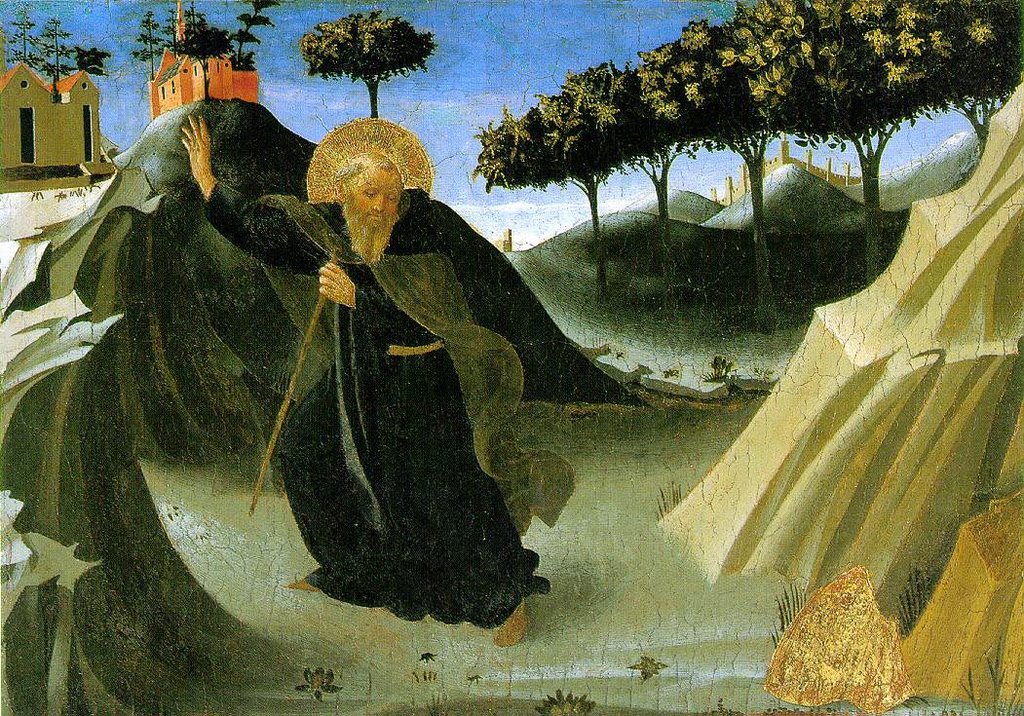
St. Anthony tempted by lump of gold.


CHAPTER IX, BOOK IV,

'LITTLE FLOWERS'


OF TEMPTATIONS


Man is unable to posses in peace the great graces which he receives from God, because many things that are contrary, disturbing and hostile arise against those graces; for the more acceptable any man is to God, the more vehemently is he assailed and buffeted by the Evil One. In order, therefore, to correspond with the grace which he receives from God, he must maintain an unceasing warfare; for the fiercer the conflict, the more glorious shall be the victor’s crown. But we have not many conflicts, nor many impediments, nor many temptations, because as yet we have advanced but a little way in the spiritual life.

True it is, however, that if a man walk warily and well in the way of God, he shall feel neither fatigue nor weariness in his journey; but the man who travels by the broad way of the world shall never be free from labour, weariness, anguish, tribulation and pain, even to the day of his death.

Then said one of the friars to Brother Giles: “Father, it seems to me that thou teachest us two things, the one contrary to the other; for thou sayest first, the more virtuous a man is, and the more acceptable to God, the greater conflicts has he to endure in the spiritual life; and next thou sayest the contrary, to wit, that the man who walks well and warily in the way of God, shall feel neither weariness nor fatigue in his journey.” To whom Brother Giles thus explained the contrariety of these two sayings: “It is most certain, my brother, that the devils bring a more fearful array of temptations against those who have a good will than against those who have not. But what harm can the devils and all the evils of this world do to the man who goes forward discreetly and fervently in the way of God, and therein labours and toils faithfully, knowing and seeing as he does that his reward shall a thousand times over-pay his labour? And further, I tell thee, of a truth, that he who is enkindled with the fire of divine love, the more fiercely he is assailed by temptations to sin, the more deeply will he hold it in abhorrence and detestation. The worst devils ever hasten to tempt a man when he is under some bodily weakness or infirmity, or when he is in some great sorrow or anguish, or in a state of tepidity, or when he is hungry or thirsty, or has received some insult or affront, or some injury, spiritual or temporal; for these wicked spirits know well that at such times, and in such circumstances, he is most open to temptation. But I say to thee, of a truth, that for every temptation and for every vice which thou shalt overcome, thou shalt acquire a virtue; and for each vice, in the conquest whereof thou shalt overcome thyself, thou shalt obtain a larger grace and a brighter crown.”

A friar once asked counsel of Brother Giles, saying: “Father, I am assailed often by an evil temptation, and I have many times besought the Lord to deliver me from it, yet he takes it not from me; counsel me, father; what ought I do?” To whom Brother Giles made the reply following: “My brother, when a king arrays one of his knights in strong armour of proof, it is a token that he requires him to fight valiantly against his enemies for love of him.”

Another friar said to him: “Father, what can I do to attain to greater fervour and love of prayer? for when I go to pray I am hard, cold, dry, and without devotion.” Brother Giles answered him thus: “A king has two servants: one of them has armour of proof, and the other has none; both desire to go forth and fight against the enemies of the king. He that is well armed enters into the battle and fights valiantly; but the other, who is unarmed, says thus to his lord:’My liege, you see that I am unarmed and defenceless; but for your love I will gladly enter into the battle and fight there all unarmed as I am.’ Then the good king, seeing the love of his faithful soldier, says to his servant: ‘Go with this my true follower, and provide him with all the armour necessary for his defence, that he may enter securely into the conflict; and emblazon his shield with my royal bearings, that he may be known as my loyal knight.’ And thus oftentimes it cometh to pass, when a man goes to prayer, that he feels himself to be naked, indevout, cold, and hard of heart; but when he puts a force upon himself, and for love of our Lord enters boldly into the battle-field of prayer, our loving Lord, and King, beholding the gallant bearing of his faithful knight, gives him, by the hands of his ministering angels, fervent devotion and good will. When a man has begun some great and laborious work, such as clearing the ground and cultivating the vine that it may bring forth its fruit in due season, he is often tempted by the great toil and manifold hindrances he meets with to weary him of his work, and even to repent him that ever he began it. But if notwithstanding he persevere until the harvest-time, he will forget all that he has endured in his joy at the fruit of his labours. In like manner he who is strong to resist temptation shall attain to great consolations; for, as St Paul tells us, after tribulation shall be given consolation and the crown of eternal life. And not only they who resist temptation shall obtain the rewards of heaven, but they shall be recompensed even in this life; as says the Psalmist: ‘Lord, according to the multitude of my temptations and my sorrows, thy consolations shall rejoice my soul.’ So that the greater the conflict and the temptations, the more glorious shall be the crown.”

A certain friar asking counsel of Brother Giles concerning a temptation, said to him: “O father, I am beset by two evil temptations; the one is, that when I do anything good, immediately I am tempted to vainglory; the other, that when I do anything evil, forthwith I fall into such sadness and despondency, that I am almost in despair.” To whom Brother Giles replied: “My brother, thou dost well and wisely to mourn for thy sins; but I counsel thee to do so discreetly and temperately, and always to remember that the mercy of God is greater than all thy sins. And if the infinite mercy of God receiveth to penance a man who is a great sinner, and who sins wilfully, when he repents: thinkest thou that the good God will forsake the man who sins not wilfully, if he also be contrite and penitent? I counsel thee likewise not to refrain from doing well, for fear of vainglory; for if the husbandman were to say in the seed-time: ‘I will not sow my seed, lest perhaps the birds come and eat it up’, assuredly he would reap no fruit that year. But if he sow his seed, although the birds may consume a portion thereof, he will gather in the greater part when the harvest comes. And so with the man who is tempted to vainglory but continually resisteth the temptation, I say that he does not by reason of it lose the merit of his good work.”

A friar said to Brother Giles: “Father, I have read that St Bernard once said the seven Penitential Psalms with so great devotion and tranquility of mind, that he thought of nothing else the whole time but of the words of the psalms he was saying.” And Brother Giles answered him thus: “My brother, I think more of the prowess of the knight who holds and valiantly defends a castle which is assailed and compassed around by enemies, so that he suffers none of them to effect an entrance, than if he were dwelling therein in peace, undisturbed by any hostile assault.”

[Public Domain.]


Thursday, August 24, 2006


CHAPTER VIII, PART IV,

'LITTLE FLOWERS'


OF HOLY CHASTITY


Our frail and miserable flesh is like to the swine, that loves to wallow in the mire, and find its delight therein. Our flesh is the devil’s knight; for it resists and fights against all those things which are pleasing to God and profitable for our salvation. A certain friar said to Brother Giles: “Father, teach me how to preserve myself from sins of the flesh.” And Brother Giles answered him: “My brother, he who wishes to move a large stone, or any other great weight, and carry it to any other place, must try to move it rather by ingenuity than by force. And so, if we desire to overcome the vice of impurity and to acquire the virtue of chastity, we must set to work rather by the way of humility and by a good and discreet method of spiritual discipline than by a rash penance and presumptuous austerity. Every vice troubles and obscures the fair glory of holy chastity; for it is like a bright mirror which is clouded and darkened, not only by contact with impure and defiling things, but even by the mere breath of man. It is impossible for a man to attain to any spiritual grace, so long as he is inclined to carnal concupiscence; and therefore, whithersoever thou turn thyself, thou shalt never be able to attain to spiritual grace until thou canst master all the vices of the flesh. Wherefore, fight valiantly against thy frail and sensual flesh, thine own worst enemy, which wages war against thee day and night. And know that he who shall overcome this mortal enemy of ours has most certainly defeated and discomfited all his other enemies, and shall attain to spiritual grace, and every degree of virtue and perfection.”

Said Brother Giles: “Amongst all other virtues, I would set the virtue of chastity first, because sweet chastity containeth all perfection in itself; but there is no other virtue which can be perfect without chastity.”

A friar asked Brother Giles, saying: “Father, is not the virtue of charity greater and more excellent than that of chastity?” And Brother Giles said: “Tell me, brother, what is there in this world more chaste than holy charity?”

Brother Giles often sang this sonnet:

O holy chastity, how good art thou!

Truly precious art thou and thy savour is sweet!

They who have not tasted thee know thee not;

Wherefore the foolish understand not thy worth.

A friar said once to Brother Giles: “Father, thou dost so often commend the virtue of chastity, that I would fain ask of thee what it is?” And Brother Giles answered: “My brother, chastity is, in very truth, the careful and continual custody of our corporal and spiritual senses, in order to preserve them pure and unstained for God alone.”

[Public Domain.]


Wednesday, August 23, 2006


CHAPTER VII, PART IV,

'LITTLE FLOWERS'


OF THE CONTEMPT OF TEMPORAL THINGS


Many sorrows and troubles shall befall the miserable man who sets his heart and desires upon earthly things, for which he forsakes and loses the things of heaven, and at last those of earth also. The eagle flieth very high; but if a weight be laid upon his wings, he can no longer soar aloft; and so by the weight of earthly things man is hindered from soaring on high, to wit, from attaining to perfection; but the wise man, who lays the weight of the remembrance of death and judgment on the wings of his heart, cannot fly and range freely amid the vanities of this world, lest they prove to him occasion of damnation. We see daily how men of the world toil and labour hard, placing themselves in many bodily dangers, to acquire its false riches; and then, after they have thus laboured and acquired, in a moment they die, and leave behind them all that they have gathered together in their lifetime. Therefore there is no dependence to be placed on this deceitful world, which deceiveth every man who trusteth in it, for it is a liar. But he who desires to be truly great and rich indeed, let him love and seek the true and eternal riches, which never satiate or weary or grow less.

Let us take example from the beasts and birds, who, when they receive their food are content, and seek only what they need from hour to hour: and so also ought man to be content with what is barely sufficient temperately to supply his needs, asking no more. Brother Giles said that St Francis loved the ants less than any other animal, because of the great care they take in the summer to gather and lay up a store of grain against the winter, but that he said that he loved the birds far better, because they gathered nothing one day for another.

But the ant giveth us an example that we should not remain idle in the summer-time of this present life, lest we be found empty and without fruit in the winter of the last and final judgment.

[Public Domain.]


Tuesday, August 22, 2006


CHAPTER VI, BOOK IV,

'LITTLE FLOWERS'


OF SLOTH


The slothful man loseth both this world and the next, because he brings forth no fruit in himself, and is of no profit to others.

It is impossible for a man to acquire any virtue without diligence and great labour. When thou canst stand in a place of safety, stand not in a place of danger.

He standeth in a safe place who painfully and diligently labours and toils in God, and for the Lord his God, not for fear of punishment or hopes of reward, but for the love of God. The man who refuses to labour and suffer for the love of Christ, truly refuses to share the glory of Christ; and thus, inasmuch as diligence is useful and profitable to us, so is negligence hurtful and dangerous.

As sloth is the way to hell, so is holy diligence the way to heaven.

Most solicitous and diligent ought a man to be in acquiring and preserving virtue and the grace of God by constant faithful co-operation with the grace vouchsafed to him; for it often happens that he loses the fruit among the leaves, and the grain amid the straw. On some our good God graciously bestows fruit with but few leaves; to others He gives fruit and leaves together; others, again, there are, who have neither fruit nor leaves. It seems to me a greater thing to know well how to guard and secretly to preserve the fruits and graces vouchsafed to us by God, than to know how to obtain them; for though a man know well how to acquire and gather up wealth, yet, if he know not well how to store it up and to preserve it, he will never be rich; while another, who carefully treasures up what by little and little he has acquired, becomes a man of great wealth.

Oh, how great a quantity of water the Tiber contain, did none of it flow away in other channels!

Man asks of God an infinite gift, a gift which hath no measure and no bound, yet he will but love God by measure and within bounds. He who desires to be loved by God, and to receive from him an infinite, immense and superabundant reward, ought to love God supremely and immensely, and to serve him without limit or cessation. Blessed is he who loves God with all his heart and with all his mind, who labours and suffers with mind and body for the love of God, and yet seeks no reward under heaven, but accounts himself only to be his debtor.

If one man were exceedingly poor and needy, and another were to say to him: “I will lend thee something very precious for the space of three days; and know, that if thou turn this thing to good account within the space of these three days, thou shalt gain infinite treasure, and become rich for evermore”; certain it is that this poor man would be most diligent in turning that precious thing to the best possible account. And so I say to thee, that the thing which God hath lent to us is our body, which is his goodness he hath lent for three days; inasmuch as our whole life here below may be compared to three days.

If, then, thou wouldst be rich, and eternally enjoy the sweetness of his divine presence, strive to make the best profit thou canst of this loan from the hand of God for the space of these three days, to wit, of this thy body, which he hath lent thee for the brief space of thy mortal life; for if thou art not diligent to labour and traffic in this present life whilst yet thou hast time, thou shalt never enjoy everlasting riches, nor repose eternally in the peaceful rest of heaven.

But if all the wealth of the world were in the hands of a man who made no use of it, either for himself or others, what would it profit either him or them? Assuredly it would be of no use or benefit whatsoever.

On the other hand, a man who possesses little, by turning that little to good account, may bring forth abundant fruit, both for himself and for others.

There is a proverb of this world which says: “Never set an empty pot to boil on the fire, expecting thy neighbour to come and fill it.” And in like manner the good God will not have thee to leave any grace empty and unused; because he never gives a single grace to any man that it should remain unused, but he gives it, on the contrary, that it should be filled and used by the performance of good works; for a good will is not sufficient unless a man fulfill it, carrying it into effect by good works.

Said a begger man once to Brother Giles, “Father, I pray thee, give me some little consolation”; to whom Brother Giles made answer: “My brother, strive to stand well with God, and then shalt thou have the consolation thou needest; for unless a man prepare within his soul a fair dwelling, in which God may abide and rest, he will never find peace or home or consolation amongst creatures.”

When any man wisheth to do evil, he needeth not much counsel how to do it; but to do well he taketh much counsel, and maketh long delay. Brother Giles said once to his companions: “My brethren, it seems to me that there is no one nowadays who wishes to do those things which he sees to be most profitable to him both in soul and body. Believe me, my brethren, for I can swear it in all truth, that the more a man shuns and avoids the yoke of Christ, the more grievous he makes it to himself, and the more heavily it weighs upon him; while the more generously a man takes it up, lending himself willingly to its weight, the lighter and the sweeter will he find it to bear. Now it is the will of God that man should labour in this world for the good of the body, provided he neglect not the good of his soul; for soul and body, without any manner of doubt, shall be united together to suffer or to enjoy for all eternity; to wit, either to suffer eternally in hell inconceivable pains and torments, or to enjoy with the saints and angels in Paradise perpetual joys and unspeakable consolations, as the reward of good works. But if a man do good without humility, it shall be turned into evil; for many there are who have done works good and praiseworthy to the eye, but because they wanted humility the works have become corrupt, thus showing that they sprang from pride; for such as have their root in humility never decay.”

A friar once said to Brother Giles: “Father, it seems to me that we have not yet learned to know our true good.” And Brother Giles replied: “My brother, it is certain that every one practices the art which he had learned, for no man can do good work unless he has first learned. I would have thee to know then, my brother, that the most noble art in the world is that of well-doing; and who can know it except he first learn it?”

Blessed is the man whom no created thing can disedify; but more blessed is he who receiveth edification from everything which he sees and hears.

[Public Domain.]


Monday, August 21, 2006


QUEENSHIP OF THE BLESSED VIRGIN MARY

WHY I LOVE THEE MARY.

{Last poem by St. Teresa}

Fain would I sing, O Mother blest! the reasons why I love thee;

Why e’en to name thy name, with joy, O Mary! fills my heart;

And why the glorious thoughts of thee, in greatness far above me,

Inspire no fear within my soul, so dear and sweet thou art.

Yet, if I were to see thee now, in majesty stupendous,

Surpassing all the crowned saints in highest heaven above,

Scarce could I dream I am thy child, (O truth sublime, tremendous!),

For I should think myself to be unworthy of thy love.

The mother, who desires to be her child’s best earthly treasure,

Must ever share its grief with it, must understand its pain.

Queen of my heart! how many years, thy sorrows had no measure;

What bitter tears thine eyes have shed, my worthless heart to gain!

So, musing on thy earthly life, in Scripture’s sacred story,

I dare to look upon thy face, and unto thee draw nigh;

For when I see thee suffering, — concealed thy marvelous glory —

It is not hard, then, to believe thy little child am 1.

When Gabriel came from heaven’s courts, to ask thee to be mother

Of God Who reigns omnipotent to all eternity,

I see thee, Mary! then prefer to that great grace, an­other, —

Through all thy consecrated life a virgin pure to be.

And so I now can comprehend, immaculate white maiden!

Why thou wast dearer unto God than heaven itself could be;

And how thy humble, human frame, with mortal weakness laden,

Could yet contain the Eternal Word, Love’s vast unbounded Sea.

I love thee when I hear thee call thyself the handmaid only

Of God, Whom thou didst win to earth by thy humility;

All-powerful it made thee then, above all women, lonely,

And drew, into thy bosom chaste, the Blessed Trinity,

The Holy Spirit, Love Divine, o’ershadowed thee, O Mother!

And God the Father’s only Son incarnate was in thee.

How many sinful, sorrowing souls shall dare to call Him — Brother!

For He shall be called: Jesus, thy first-born, eternally.

And oh! despite my frailties, dear Mary! well thou knowest

That I at times, like thee, possess the Almighty in my breast.

Shall I not tremble at the gift, O God! that Thou bestowest ?

A mother’s treasure is her child’s: — I still my fears to rest.

For I, O Mary, am thy child! O Mother dear and tender.

Shall not thy virtues and thy love plead now with God for me?

Then, when the pure white sacred Host, in all its veiled splendor,

Visits my heart, thy spotless Lamb will think He comes to thee.

Oh, thou dost help me to believe that e’en for us, frail mortals,

‘Tis not impossible to walk where we thy foot­steps see;

The narrow road before us now, thou lightest to heaven’s portals.

Who lowliest virtues here below didst practise perfectly.

Near thee, O Mother! I would stay, little, unknown and lowly;

Of earthly glory, oh! how plain I see the vanity!

In the house of St. Elizabeth, thy cousin dear and holy,

I learn of thee to practise well most ardent charity.

There, too, I listen on my knees, great Queen of all the Angels!

To that sweet canticle that flows in rapture from thy soul;

So dost thou teach me how to sing like heavenly, glad evangels

And glorify my Jesus, Who alone can make me whole.

Thy burning words of love divine are mystic flowers victorious,

Whose fragrance shall embalm the long, long, ages yet to be.

In thee, indeed, the Almighty King hath done great things and glorious!

I meditate upon them now, and bless my God in thee.

When good St. Joseph did not know the great arch­angel’s story,

Which thou wouldst fain conceal from men in thy humility,

O tabernacle of the Lord! thou didst not tell thy glory,

But veiled the Saviour’s presence in profoundest secrecy,

Thy silence, how I love it now, so eloquent, so moving!

For me it is a concert sweet, of melody sublime;

I learn thereby the grandeur of a soul that God is proving,

That only looks for help from Him and in His chosen time.

Then later still, O Joseph! and O Mary! I behold you

Repulsed in little Bethlehem by all the dwellers there;

From door to door you vainly went, for all the people told you

They had no place to shelter you, no time to give you care.

Their rooms were for the great alone; and in a stable dreary

The Queen of Heaven gave birth to Him Who made both heaven and earth.

O Mother of my Saviour! then, thou wast not sad nor weary;

In that poor shed how grand thou wert! how pain­less was that Birth!

And there when, wrapped in swaddling bands, I see the King Eternal, —

When of the Word divine, supreme, the feeble cry I hear —

O Mary, can I envy e’en the angels’ joy supernal?

The Master Whom they worship is My little Brother dear.

What praises must I give to thee, who, in earth’s gloomy prison,

Brought forth this lovely heaven-sent Flower, before our eyes to bloom!

Though unto shepherds and wise men a star had grandly risen,

These things were kept within thy heart as in some secret room.

I love thee when I see thee next, like other Hebrew women,

To Israel’s temple turn thy steps when dawned the fortieth day;

I love thee yielding humbly up, to aged, favored Simeon,

The Lord Who should redeem us all when years had fled away.

And first my happy smiles awake, to hear his glorious singing, —

That “Nunc Dimittis” that shall ring till Time itself shall die;

But soon thosejoyous notes are changed, and my hot tears are springing; —

“A sword of grief must be thy lot,” thus runs his prophecy.

O Queen of all the martyr-host! till thy life here is ended,

That sharp, sharp sword shall pierce thy heart! At once, it pierces sore.

That thy dear Child from Herod’s wrath may surely be defended,

I see thee as an exile fled to Egypt’s pagan shore.

Beneath thy veil thy Jesus slept, thy peace no fears were daunting,

When Joseph came to bid thee wake, and straight­way flee from home;

And then at once I see thee rise, as called by angels chanting,

Content, without a questioning word, in foreign lands to roam.

In Egypt and in poverty, I think I see thee, Mary,

All glad at heart, all radiant, with joy beyond compare.

What matters exile unto thee? Thy true home cannot vary.

Hast thou not Jesus, with thee still? and with Him Heaven is there.

But, oh! in fair Jerusalem, a sorrow, vast, unbounded,

Indeed o’erwhelmed thy mother-heart with grief beyond compare; —

For three days Jesus hid Himself; no word to thee was spoken.

Thou truly wast an exile then, and knew what exiles bear.

And when, at last, thine eyes again were thy Son’s face beholding,

And love entranced thee, watching Him among the doctors wise,

“My Child!” thou saidst, “now tell me why didst leave my arms enfolding?

Didst Thou not know we sought for Thee with tear-endimmed eyes?

The Child-God answered to thee then, to thy sweet, patient wooing,

O Mother whom He loved so well, whose heart was well-nigh broken!

“How is it that you sought for Me? Wist not I must be doing

My Father’s work?” Oh, who shall sound the depths those words betoken?

But next the Gospel tells me that, in His hidden mission,

Subject to Joseph and to thee was Christ, the Holy Boy;

And then my heart reveals to me how true was His submission,

And how beyond all words to tell, thy daily, per­fect joy.

And now the temple’s mystery I understand, dear Mother!

The answer, and the tone of voice, of Christ, my King adored.

‘Twas meant the pattern thou shouldst be, thereafter to all other

Tried souls who seek, in Faith’s dark night the coming of the Lord.

Since Heaven’s high King has willed it so His Mother and His dearest

Should know the anguish of that night the torn heart’s deepest woe,

Then are notthose, who suffer thus, to Mary’s heart the nearest?

And is not love in suffering God’s highest gift below?

All, all that He has granted me, oh! tell Him He may take it!

Tell Him, dear Mother! He may do whate’er He please with me;

That He may bruise my heart to-day, and make it sore, and break it,

So only through Eternity my eyes His Face may see!

I know, indeed, at Nazareth, O Virgin rich in graces!

As the lowly live, so thou didst live, and sought no better things;

Of ecstasies and wonders there, our eyes can find no traces,

O thou who daily dwelt beside the incarnate King of Kings!

On earth, we know, is very great the number of the lowly;

With neither fear nor trembling now we dare to look on thee.

By common lot and humble path, our Mother dear and holy,

Thou wast content to walk to heaven, and thus our guide to be.

Through all my weary exile here, I fain would walk beside thee.

O my pure and precious Mother! be near to me each day!

Thy beauty thrills my heart with joy. Deign now to guard and guide me!

What depths of love are in thy heart for me thy child, alway!

Before thy kind maternal glance, my many fears are banished;

Thou teachest me to gently weep, and then to sing for joy;

Thou dost not scorn our happy days, nor hast thou wholly vanished;

Thou smilest on us tenderly, as once upon thy Boy!

When bride and groom at Cana’s feast knew well the wine was failing,

And knew not whence to bring supply, their need thine eyes perceived,

To Christ, the Master, thou didst speak, who knew His power availing, —

The Maker of created things, in Whom thy soul believed.

But first He seemed thy mother-heart’s kind prayer to be denying.

“What matters this, O woman! unto Me and thee?” said He.

But “Mother,” in His soul’s deep depths, His filial heart was crying;

And that first miracle He wrought, Mother, lie wrought for thee.

One day, while sinners crowded round to hearwhat He was saying,

In His desire to save their souls and them to heaven beguile,

Lo! thou wast there amid the throng, and thou wast meekly praying

That they would let thee nearer come, and speak with Him awhile.

And then thy Son spoke out this word mysterious like that other.

To show us thus His marvelous love for all the souls of men; —

He said: “Who is My brother, and My sister, and My Mother?

‘Tis he who does My Father’s will!” The Father’s will, again!

O Virgin, pure, immaculate! O Mother, tenderest, dearest!

Hearing these words that Jesus spake, this time thou wast not grieved.

No! thy great heart it leaped for joy, O thou His friend the nearest!

Because our longing souls likewise to kinship He received.

Oh, how thy heart is glad to know His love to us is given, —

The treasure, that cannot be weighed, of His Divinity!

Who shall not love thee well to-day, and bless thee in high heaven,

Seeing thy tender care for us, thy generosity!

For truly thou dost love us all as thy Child Jesus loves us;

And for our sake thou didst consent to stay when He had risen.

Since, if we love, then all to give, e’en self, both tries and proves us,

So thou, to prove thy love, didst stay in earth’s dark, dreary prison.

Thy love for souls our Saviour knew, that love His heart had sounded;

He left thee to us when He went to God’s right hand on high.

Refuge of sinners! on thy prayers how many hopes are grounded!

Christ gave thee to us from His cross; for us He hears thy cry.

For thou — His Mother — there didst stand, that awfulday, on Calvary;

As a priest before God’s altar, at the cross so thou didst stand.

And to appease the Father’s wrath, didst offer up, O Mary!

Thy Jesus, our Emmanuel, at God’s supreme command.

A prophet had foretold this thing, O Mother broken­hearted!

“Is any sorrow like to thine?” Thy grief no words can say!

Blest Queen of martyrs! left on earth when Jesus had departed!

‘Twas thy heart’s blood for us was given on that unequalled day.

Henceforth thy shelter in thy woe was St. John’s humble dwelling;

The son of Zebedee replaced the Son Whom heaven adored.

Naught else the Gospels tell us of thy life, in grace excelling;

It is the last they say of thee, sweet Mother of my Lord!

But that deep silence, oh! I think it means that, up in glory,

When time is past, and into heaven thy children safe are come,

The Eternal Word, my Mother dear, Himself will tell thy story,

To charm our souls, thy children’s souls, in our eternal home.

Soon I shall hear that harmony, that blissful, wondrous singing;

Soon, soon, to heaven that waits for us, my soul shall swiftly fly.

O Thou who cam’st to smile on me at dawn of life’s beginning!

Come once again to smile on me. . . . Mother! the night is nigh.

I fear no more thy majesty, so far, so far above me,

For, I have suffered sore with thee; now hear my heart’s deep cry!

Oh! let me tell thee face to face, dear Virgin! how I love thee;

And say to thee forevermore: thy little child am I.

St. Teresa of Lisieux, May,1897. Public Domain.